What accounts payable needs procurement to get right
Why the exceptions AP chases every month start with decisions procurement made three weeks earlier.

Key Takeaways
- A handful of unglamorous fixes at the PO stage can keep most exceptions from ever reaching AP's queue
- AP is rarely in the room when procurement systems get chosen, and the close shows it
- Not every "accounting integration" means the same thing, and the difference is what makes or breaks month-end
A controller's month-end view tells you a lot about how a contractor really works. Invoices land all week, and by the end of it some percentage of them (a share that varies but rarely shrinks) have something on them that isn’t aligned with the purchase order or the materials that actually arrived. Each exception is small in isolation, and each one takes a real conversation upstream to resolve: with the PM who signed for the delivery, with the purchaser who issued the PO, or with the foreman who logged the receipt (or didn't). The exceptions pile is what the month-end close gets built around, and how big it is on the last day of the month traces back to how procurement decided to capture the transaction three weeks earlier.
This piece is for the AP manager, the controller, and the CFO who has noticed that the month-end close keeps feeling like archaeology and would like to know what to change to make the process easier. The short version is that the procurement-system choices made upstream determine how much of your month-end is reconciliation and how much is just review.
Why the AP exception pile is a procurement decision
The instinct is to read invoice exceptions as AP's problem to fix faster, with more automation in the matching, another AP clerk, or longer payment terms while the queue gets worked on. The instinct misreads where the exceptions are coming from. The exception is the artifact of an upstream decision: a line item that was vague when the PO was issued, a job code that was optional instead of mandatory, an artifact that landed in AP's queue out of the wrong system, a receipt that closed against a different record than the invoice references. AP did not create those gaps; AP inherits them, every month, and the only durable fix runs in the other direction. Across construction, 52% of rework traces to bad data, and a share of it lands first as the invoice AP can't post.
Naming the upstream cause clarifies what AP discipline actually means in this workflow (matching, validating, flagging, and escalating cleanly inside a system that gives AP the right artifacts to work with), rather than absolving AP of the work. Procurement discipline is producing those artifacts in the first place. When the procurement layer is loose (and most procurement layers were not designed with the AP chair in mind), AP's discipline gets spent on rework that should never have reached the queue. Only 26% of contractors rate their data quality as high, and the gap shows up in AP's queue first. The exception pile is where the three numbers come apart; the procurement system is where the three numbers either stay together or don't.
Where procurement quietly breaks AP
The failure modes are unspectacular, which is part of why they survive. They are the small, accumulating decisions any procurement workflow makes hundreds of times a week, and they read differently from the AP chair than from the procurement chair. The table below names the most common ones and what the procurement system would have to do differently to keep them out of AP's queue.
None of these are dramatic, and that is the point. They are the boring upstream choices that compound into the exception queue, and each one is a procurement-system setting or workflow that AP rarely gets to weigh in on. Each one of them shows up on AP's desk later as an invoice that won't post.
What clean upstream looks like for AP
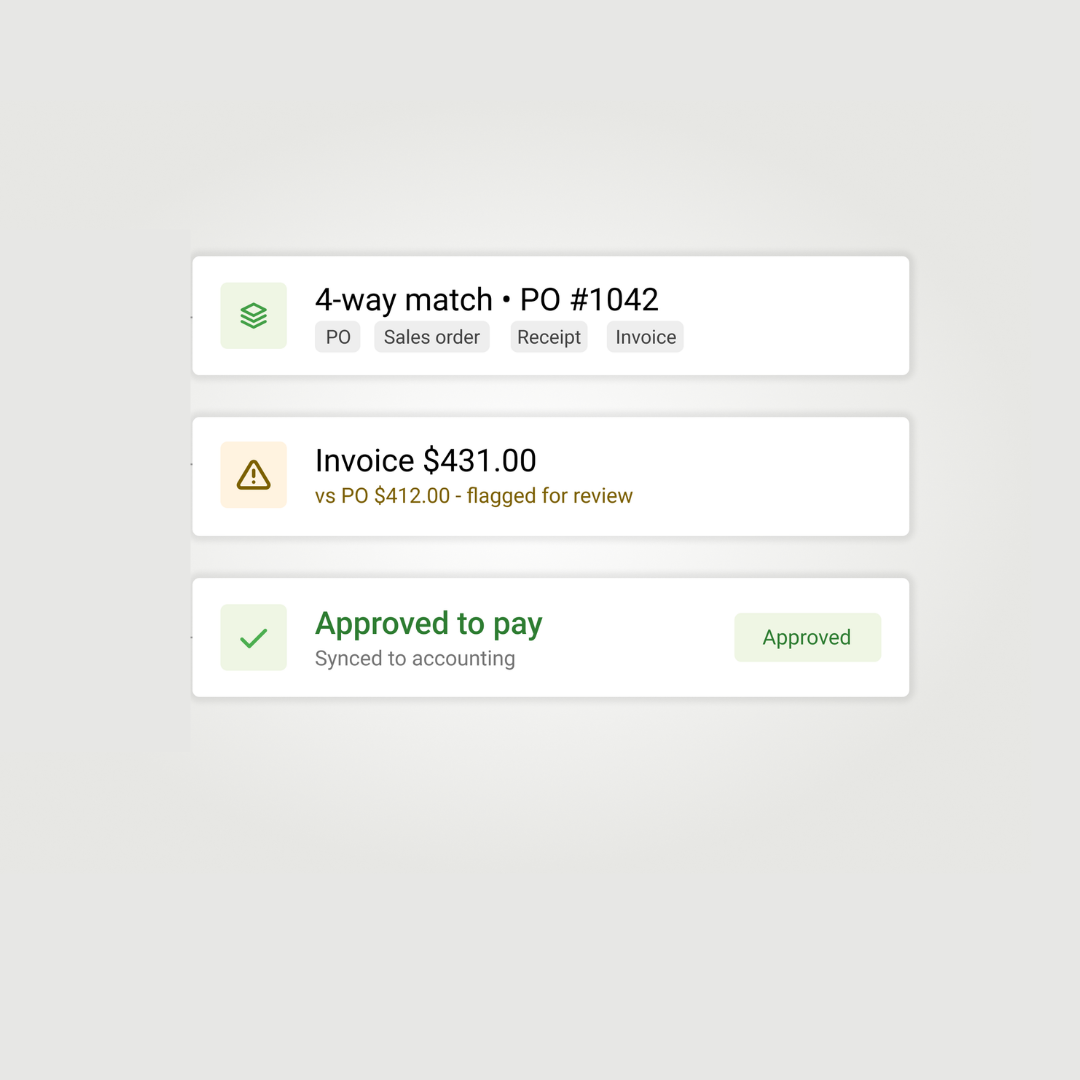
Naming the failure modes implies the affirmative criteria, and procurement built with AP downstream in mind does a short list of things consistently. It enforces line-item structure at the source so the description survives all the way to the invoice. It treats the job code as a required field instead of an optional one. It exports the released purchase order as the AP-side artifact, with requisitions and quotes left as upstream working documents. It closes receipts against the same PO record so what three-way matching actually catches is the real exceptions and not its own broken trail. It flags pricing and quantity drift before payment, rather than after. None of that is exotic, and most of it is what separates a procurement system that reads as competent from one that reads as deep.
The depth question is where accounting integration matters specifically. Integration in the brochure sense ("syncs with QuickBooks") usually means a nightly CSV that picks up the invoice and drops it in. Integration in the AP sense means the PO, the receipt, the invoice, and the GL coding are the same record carried across systems, with three-way matching built into the workflow instead of left to AP to assemble from three exports. That distinction is hard to spot in a demo and yet obvious in a month-end close.
What AP managers should ask for at the procurement-system table
Most procurement-system selections happen without AP in the room. The buyers' committee is usually some combination of the purchasing manager, the operations leader, the CFO, and one or two field leads, and the questions asked tend to be about supplier coverage, mobile usability, and price. AP shows up after the choice has been made, inherits whatever the system exports, and is judged on how cleanly the month-end close runs.
The fix is to be there earlier, and to bring a short, specific list. AP's questions for a procurement-system evaluation look different from the rest of the committee's questions, and they are the ones that decide whether the close will get better or stay the same:
- What document does this system export as the AP-side artifact, and is it the released PO with amendments preserved, or is it something earlier in the workflow?
- Is job-coding enforced at PO release, or can a PO move without it?
- How does the system handle partial deliveries, and does the receipt close against the same record as the invoice?
- What is the path for a new supplier added at the field's request, and does that path produce the vendor master and the GL mapping before the first invoice arrives?
- Where does the system flag pricing and quantity discrepancies, and does that flag appear before payment is scheduled or after it has cleared?
- What does the accounting integration actually move: the full record set, or a synced invoice with everything else left for AP to assemble?
A procurement-system selection that runs those questions through AP before the contract gets signed will produce a noticeably different month-end. A selection that doesn't will produce the same exception pile, on a different vendor.
The procurement layer designed with AP downstream in mind
There is a small set of procurement platforms built for contractors with the AP side of the workflow in mind from the start. Remarcable is one of them: 15 accounting-system integrations with three-way matching built into the workflow rather than left to AP to assemble. Line-item structure enforced at the source, and an AP-facing AI feature called InvoiceSense that flags billing discrepancies before payment rather than after. The export discipline the AP questions are pointing at is the discipline the system was designed to enforce upstream, so the artifact AP matches against is the released PO with the line items, job codes, and receipts intact. A platform that does this well makes AP's month feel different; one that does it badly leaves AP doing the same archaeology, on a different vendor's CSV.
The month that quietly feels different
A clean month-end has the quiet quality of not being noticed: no fire drills, no conversations that begin "do you remember when you signed for this?", no exception pile that hides the rest of the work. When the procurement system AP runs was chosen with AP at the table, that absence is what shows up. The exception queue is shorter because most of the exceptions never got generated upstream. The trails AP does have to run are shorter because the artifacts are the right ones. The close lands on its planned calendar instead of the one the exception queue used to dictate.
That outcome belongs to procurement and AP jointly, and it gets decided well before the first invoice of the month lands. The fix is procurement-system discipline on the upstream side, chosen with AP's questions answered first; faster matching downstream cannot recover what got captured wrong three weeks earlier. Procurement systems built for contractors with the AP chair represented in the design make a clean month-end close easy. The AP manager's most important contribution to that outcome is being in the room when the procurement system is chosen.
Connected purchasing and material operations for MEP contractors
See how contractors run procurement with Remarcable
Request a demo and we'll walk through exactly how it fits your team's workflow.