AI hype or AI value?
Construction tech is wallpapered in AI claims this year. Here's how contractors can tell the hype from the actual value.


Key Takeaways
- AI is a buying criterion, not just a marketing claim.
- Choose software that makes your team's day measurably easier.
- Ask about workflow: specific answers are value, adjectives are hype.
- The best AI disappears, making your current tools smarter.
Walk any construction tradeshow floor this year and you'll hear the same word. AI. Every product demo opens with it. Every tech company's homepage promises it. Nearly every cold email leads with it.
Meanwhile, your foreman is still texting a photo of a cardboard box top with a material list written with a Sharpie. Your purchaser is keying line items from a supplier sales order into your ERP. Your AP team is chasing down why an invoice came in 15% higher than the PO. And somewhere in the office, a PM is double-ordering material that's already on the job site.
The AI label on the software hasn't changed any of that. Contractors don't need AI for the sake of AI. They need software that uses AI to make the everyday work easier, faster, and more accurate — inside the workflows their teams already depend on.
The question isn't whether a platform has AI in it. Every platform has AI in it. The question is whether the AI actually changes someone's day.
"AI" on a homepage tells you almost nothing
Calling your software AI-native in 2026 is like calling it "web-based" in 2010. Of course it is! Every software company building today has AI somewhere in its stack. The label is table stakes. It's not a differentiator.
In 2026 saying your software is "AI native" is like saying "web-based" in 2010. Of course it is! Every company is now AI native. It's not a differentiator.
What gets harder to see, from the outside, is what the AI is actually native to.
Sometimes the answer is one capability dressed up as an identity — a document scanner with no supplier connectivity behind it. AI-powered OCR has been around for more than a decade. Calling it AI in 2026 doesn't make it new. Maybe it's an AI chatbot stapled onto a product the field teams won't adopt. That's just more overhead for no return. The useful question to a claim of AI-native, every time, is: native to what?
What the website says vs. What a contractor should hear
If you've sat through more than a few demos this year about AI, you've probably noticed a pattern. The vocabulary is borrowed from somewhere else — venture capital decks, Silicon Valley product blogs, enterprise software analyst reports. Too many websites are built for the next round of investment, not the contractor looking to solve a problem using the language construction uses.
Here's the rough translation guide, written from the perspective of a contractor reading those websites at the end of a long day:
AI-Native Platform
Built using AI somewhere in the product — like every other software platform built in 2026. The phrase tells you nothing about which workflows the AI touches or what changes in your day.
Ask: Which specific tasks does it automate, and what's the accuracy rate?
End-to-End Visibility
Built using AI somewhere in the product — like every other software platform built in 2026. The phrase tells you nothing about which workflows the AI touches or what changes in your day.
Ask: End of what, to end of what — and what's outside that loop? Does this run alongside my ERP, my accounting system, and my supplier connections?
AI Copilot for the Trades
A chatbot, usually built on a general-purpose AI model and prompted with trade-specific content. Helpful for quick lookups and explanations. Risky if it touches money, schedules, or commitments without a human review step.
Ask: What does the copilot do that I can't easily undo, and who reviews it before that happens?
Software That Speaks Contractor
A marketing claim. Software can't speak contractor — the people who built it, support it, and write about it have to. The honest tell is in the next paragraph of the vendor's own website or sales deck: does it read like someone who's worked in construction wrote it, or like a Silicon Valley pitch deck?
Ask: Who on your team has actually worked in the trades? Can I talk to them?
Operating System for Construction
The phrase is borrowed from consumer tech (iOS, Android). Whether it's actually load-bearing infrastructure depends on whether it connects all the systems you already run. Unless other software companies are building software on top of it, it's not an operating system.
Ask: What software, other than yours, is built on this operating system?
Built for the Built World or Construction Intelligence
A tagline. Tells you the vendor markets to construction. Tells you nothing about whether the product fits how your specific trade — electrical, mechanical, plumbing — actually works day to day.
Ask: Show me what part of the product is intelligence that is designed to work alongside my team.
Generative AI for Construction
A general-purpose AI model — the kind behind ChatGPT — applied to construction tasks. Powerful for drafting and summarizing. A risky fit for anything in your accounting workflow, where invented numbers cost real money.
Ask: Where in the workflow does the generative AI touch dollars? And what's the human review step before it commits anything?
Self-Learning Platform
Software that adjusts its outputs as it sees more of your data. Useful if the learning improves things you care about. Worth asking what the platform is learning and what happens to what it learns about your business.
Ask: What is the AI learning from my data, and is that learning staying inside my account or being used elsewhere?
None of these claims are wrong. They're just empty without more details. They don't tell a contractor anything about what changes when they purchase software. And contractors, who are practical and busy and skeptical by experience, don't need more software.
The cure isn't softer AI talk. The cure is specific AI talk. AI that touches a real workflow, replaces a real task, and produces a result a real person can see.
The Better Question: What Workflow Does This Make Easier?
Workflow-native is the standard worth holding vendors to. It means the AI is built into the work your team is already doing, not bolted on as a separate tool they have to learn. They don't open the AI. They open the software they use every day, and the AI works behind the scenes.
For procurement and material management, workflow-native AI shows up across the stack like this:
Procurement and supplier communication. For suppliers who are integrated, orders flow directly into their ERP instead of landing in an email. For all other suppliers AI reads supplier PDFs — quotes and invoices, in whatever format each supplier sends — and converts every line item, price, and quantity into structured data ready for your ERP. And every conversation about a substitution, a backorder, or a pricing question lives with the order it belongs to.
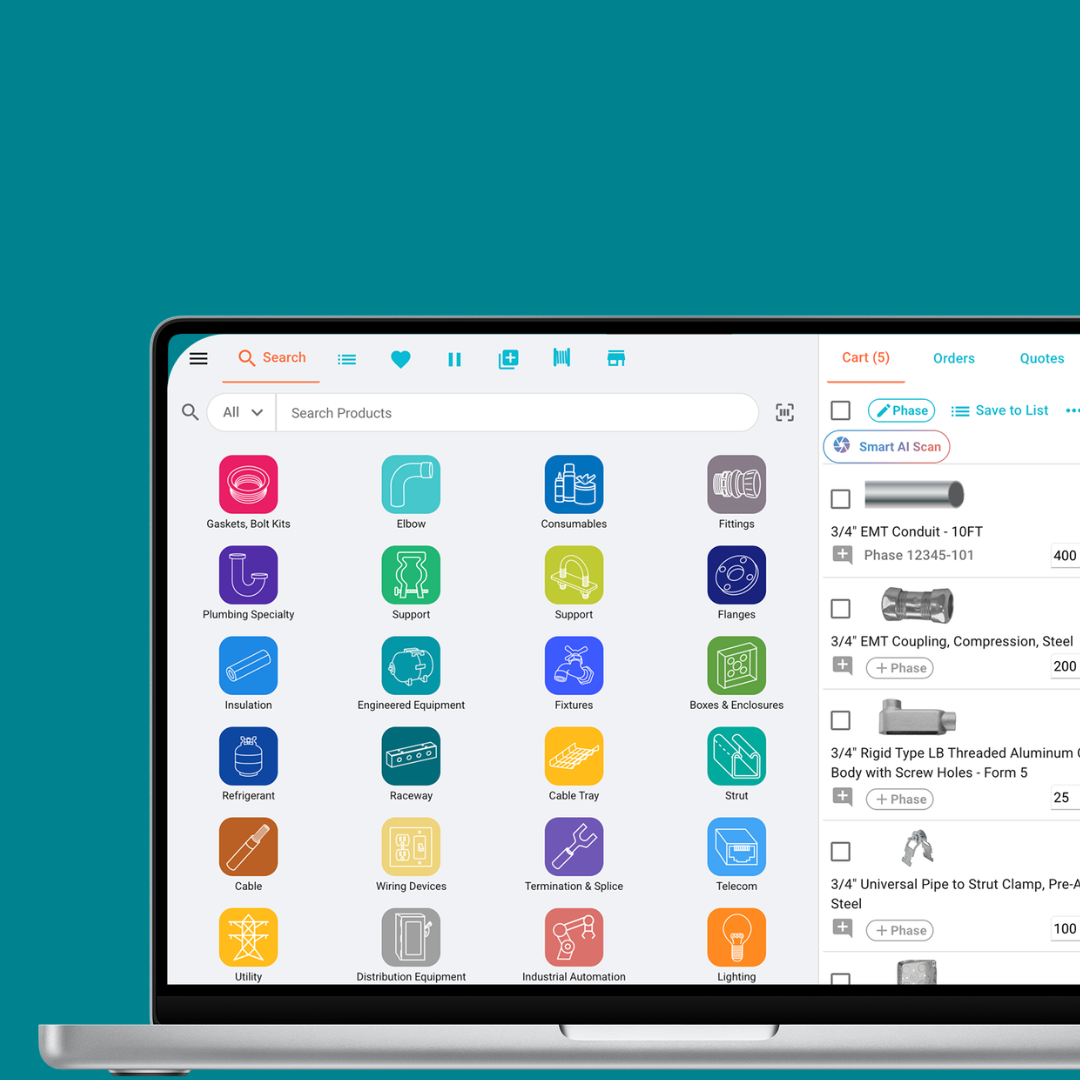
Materials, inventory, and field ordering. AI surfaces the most popular items based on your company's ordering history. Visual catalogs let the crew order by picture instead of part number. Slang mapping means a foreman can request what they actually call it and the system maps it to the right SKU. Recommendations prompt the next item before someone forgets a fitting. Real-time visibility into what's already been ordered prevents double-ordering material that's sitting on the truck.
Tools and prefab. When tools and prefab workflows live in the same system as procurement, the AI catches the disconnect that usually lives between the trailer, the shop, and the office. Standard SKUs get industrialized. Labor hours that used to go into manual repetition come back to the business.
Accounting and job cost visibility. AI-powered 4-way matching compares the PO, the supplier sales order, the receipt from the field, and the invoice — and flags pricing or quantity discrepancies automatically. Committed cost, actual cost, and outstanding cost stay visible in real time, instead of variance showing up in the P&L three weeks after the job closes.
That's a lot of workflows. The point is that the AI isn't an event — it's a quiet presence across the whole procurement lifecycle. The contractor doesn't have to think about it. The work just goes faster.
AI isn't an event — it's a quiet presence across the whole procurement lifecycle. The contractor doesn't have to think about it. The work just goes faster.
The Trust Posture That Separates Real AI From Hype
Many vendors making AI claims cannot, or will not, plainly say three things. The vendors worth taking seriously will say all three on the same page:
One — the AI is extractive, not generative. It reads real data from real documents and matches it against real product catalogs and supplier records. It does not invent line items. It does not hallucinate prices. Generative AI has a place — answering product questions in a support chat, for example — but it does not belong in your accounting workflow.
Two — there is a human review step. Every AI extraction should be reviewable and approvable before anything flows to your ERP. Auto-approval is a setting you choose for clean matches, not a default the vendor imposes.
Three — your data is yours. Used to deliver the service you bought, not to train somebody else's general-purpose AI, not sold, and not ever shared with competitors. Single sign-on, role-based access, and a full audit trail on every transaction.
If a vendor cannot answer all three plainly, the AI claim is doing more marketing work than the AI is doing.
Six Questions to Ask Any Vendor Making an AI Claim
Bring these into your next demo. Make the vendor answer with the actual product on the screen — not a slide.
- What workflow does your AI change? Not what it is. What it does.
- Whose day changes when it works? The foreman? The purchaser? The AP clerk? The CFO?
- What did it replace? A spreadsheet? An email thread? A phone call?
- Can my team review it before anything hits our ERP? If the answer isn't a confident yes, pass.
- Does it read real documents, or does it generate text? Extractive AI is for accounting. Generative AI is for chatbots. Don't mix them up.
- How long until my team feels the difference? If the answer is after a six-month implementation, it isn't AI. It's a project.
A vendor with real AI in real workflows can answer those questions inside fifteen minutes, with the product open in front of you. A vendor with hype will pivot to a slide deck. If they can't demo it in the product, you won't see it in the product.
The Closing POV
AI shouldn't add another tool to your stack. It should make the tools you already use smarter, quieter, faster, less error-prone. The best AI for contractors is the AI that disappears into the work. Fewer missed details. Less manual chasing. Cleaner handoffs between field, office, purchasing, prefab, AP, and suppliers.
That isn't a marketing claim. It's a buying criterion.
Construction is hard enough. Material buying shouldn't be. The software you choose should make your team's day measurably easier — not give them one more thing to learn.
When a vendor leads with AI, ask the questions above. If the answers come back grounded in your workflow, you're looking at something useful. If they come back wrapped in adjectives, you've found the hype.
Connected purchasing and material operations for MEP contractors
See how contractors run procurement with Remarcable
Request a demo and we'll walk through exactly how it fits your team's workflow.
.png)