What Is 3-Way Matching in Construction and Why It Protects Your Margins
3-way matching compares purchase orders, receiving records, and invoices before you pay.

You approved a purchase order for $5,000 in conduit. The invoice arrives for $5,400. Without a system to catch that difference, you just paid an extra $400.
That scenario plays out constantly in construction. Suppliers change prices after quotes. Invoices bill for quantities that never showed up on the job site. Freight charges appear that weren't in the original agreement. Each discrepancy is small enough to slip through, but across hundreds of invoices per month, the cumulative impact on already thin margins is significant.
3-way matching is the process that catches these discrepancies before you pay. It compares three documents: what you agreed to buy, what actually arrived, and what you're being billed for. When all three align, you pay with confidence. When they don't, you investigate before cutting a check.
For electrical and mechanical contractors operating on tight margins, this isn't accounting busywork. It's margin protection.
What is 3-way matching?
3-way matching compares three documents before approving payment on any invoice:
Purchase order (PO): The document that records what you agreed to buy. It includes the vendor, item descriptions, quantities, unit prices, job codes, and delivery terms. This is your baseline for what the transaction should look like.
Receiving record (delivery note or goods received note): Proof that materials actually arrived. This could be a signed packing slip, a photo from the foreman, or an entry in your inventory system. It confirms what was delivered, when, and in what condition.
Supplier invoice: The bill requesting payment. It lists quantities, prices, and any additional charges like freight or taxes.
The matching process compares these three documents line by line. If the invoice charges for 100 fixtures but the receiving record shows only 80 arrived, that's a discrepancy. If the unit price on the invoice is higher than the unit price on the PO, that's a discrepancy. If freight charges appear that weren't on the original order, that's a discrepancy.
Only when all three documents align does the invoice get approved for payment.
The three documents and what has to match
Each document serves a specific purpose in the matching process, and specific fields need to align across all three.
The receiving record won't have pricing information since that's not the field team's concern. But it's the critical link that proves materials actually arrived before you pay for them.
Without that middle document, you're doing 2-way matching: comparing the PO to the invoice. That catches price discrepancies but misses the fundamental question of whether you actually received what you're paying for.
Common discrepancies that cost you money
Invoice errors rarely look like fraud. They look like small differences that seem easier to pay than to investigate. But those differences add up.
Billed for materials not received. The invoice shows 100 light fixtures. The delivery record shows 80 arrived, with 20 on backorder. Without matching, you pay for all 100 and hope the backorder eventually shows up.
Quantity billed exceeds quantity delivered. Partial shipments are normal in construction. Materials arrive across multiple deliveries over days or weeks. If invoices don't match receiving records, you may pay twice for the same materials or pay for quantities that never arrived.
Price increases after the quote. You negotiated $2.50 per foot for wire. The invoice bills at $2.75. Maybe copper prices moved. Maybe the supplier's system defaulted to list price instead of your contracted price. Either way, you're overpaying unless someone catches it.
Unauthorized substitutions. The PO specified Brand A panels. Brand B arrived and was installed because the crew needed to keep moving. The invoice charges Brand B at a higher price. Was that substitution approved? Did anyone update the PO?
Duplicate billing. The same PO, same materials, two invoices. Same packing slip invoiced by different people at the supplier. Same delivery billed once on a progress invoice and again on a final invoice.
Freight and tax beyond agreed terms. The quote said freight included. The invoice adds a $200 freight charge. The PO was tax exempt. The invoice includes sales tax.
None of these are necessarily malicious. Suppliers make mistakes. Their systems have defaults that override negotiated pricing. Their sales teams and billing department don’t always communicate seamlessly. But every error that slips through comes directly out of your margin.
Why construction makes 3-way matching harder
If you've ever tried to match an invoice to a purchase order in construction, you know it's rarely straightforward. The industry has structural challenges that make matching more complex than in other businesses.
Partial deliveries across multiple shipments. A single PO might generate five or six deliveries over two weeks. Each delivery has its own packing slip. The invoice may cover some or all of those deliveries, or split them differently than when the deliveries arrived.
Materials split across job sites. One PO for wire might be allocated 60% to Job A and 40% to Job B. The delivery goes to the warehouse, gets split, and ships to two different sites. The invoice shows one line item. The receiving records show two locations. Matching them requires job level tracking.
Price volatility. Copper, steel, and other commodity materials fluctuate constantly. A price quoted last month may not be valid today. Change orders get approved verbally and documented later. Suppliers adjust prices mid-project and expect you to accept the increase.
Hold for release orders. You place a large PO to lock in pricing, but materials ship incrementally as job sites become ready to receive them. The supplier bills on shipment. Matching requires tracking what's been released versus what's still held and against what's been invoiced to date.
Change orders mid-project. Scope of work changes. The PM approves additional materials by phone. The PO gets amended, or maybe a new PO gets created, or maybe the approval only exists in an email thread. When the invoice arrives, reconciling it to the original order plus changes requires digging through various communications or requires follow-up.
These aren't edge cases. They're Tuesday, or everyday. They are why manual 3-way matching in construction becomes a full time job.
Is the administrative burden worth it?
Here's the honest answer: 3-way matching adds steps to your payment process. It requires documentation that might not exist today. It slows down invoice approval when discrepancies need investigation.
For some contractors, that burden isn't worth it. If you're doing $3 million annually with two trusted suppliers you've worked with for 20 years, and your owner reviews every invoice personally, adding formal matching processes may create more friction than value.
But for contractors at scale, the math changes.
Consider a mechanical contractor doing $5 million annually in time and materials work. Industry data shows that 8 to 12 percent of invoiced hours on T&M (time and materials) work get disputed. At a $75 per hour loaded labor rate, that's $30,000 to $45,000 per year in disputed charges. That's just labor billing. Material invoices have their own error rates.
Or consider the inverse: what happens when you don't catch errors? A single supplier overcharging by 2% on a $500,000 annual spend costs you $10,000. That's pure margin loss on work you’ve already done.
The following threshold approach makes sense for most contractors:
Full 3-way matching for purchase orders above a certain dollar amount, typically $1,000 to $2,500 depending on your volume. Also for any equipment rentals, subcontracts, or volatile priced materials like copper wire.
2-way matching (PO to invoice only) for mid-range purchases where you trust the supplier and delivery is straightforward.
No formal matching for small consumables and emergency purchases, but subject to periodic audit.
This tiered approach protects the 80% of the dollars that matter without drowning your AP team in paperwork for every box of wire nuts.
How to set up 3-way matching without dedicated AP staff
Most electrical contractors don't have a dedicated accounts payable department. The controller handles AP along with everything else, or a bookkeeper splits time between payroll, billing, and vendor payments.
3-way matching still works. The key is distributing the documentation burden to where the information actually exists.
Step 1: Establish PO discipline. Every material purchase above your threshold needs a purchase order before anything ships. No PO, no payment. This sounds simple but requires enforcement. Suppliers learn quickly when unpaid invoices start backing up.
Step 2: Make the field accountable for receiving. When materials arrive, the foreman or site lead checks the delivery against the packing slip. Quantities match? Items undamaged? They mark the packing slip "OK" or note discrepancies, sign it, and send a photo to a central email or enter it into your system.
This takes 2 minutes per delivery. It creates the receiving record that makes matching possible. Without it, your AP person is calling job sites trying to verify whether materials arrived.
Step 3: Centralize document collection. Set up one email address or one location where all three documents flow: POs from purchasing, receiving confirmations from the field, invoices from suppliers. Require suppliers to include the PO number on every invoice.
Step 4: Match in batches, not real time. Rather than matching each invoice as it arrives, batch the process. Once or twice per week, pull invoices with their corresponding POs and receiving records. Match in bulk. Flag exceptions for investigation.
Step 5: Set approval thresholds. Invoices that match cleanly below a certain dollar amount get approved by AP. Above that threshold, the PM or Operations manager reviews before approval. This keeps routine invoices moving while adding oversight for significant purchases.
Step 6: Handle exceptions, not every invoice. The goal isn't for someone to manually compare every line of every document. The goal is a process where clean invoices flow through and only exceptions require attention. "This invoice has a price variance of $340" is actionable. Reviewing every invoice line by line is not sustainable.
Step 7: Enforce vendor compliance. Suppliers who consistently send invoices without PO numbers, who frequently have price discrepancies, or who bill for quantities not received need direct conversations. Some contractors move chronic offenders to stricter terms or find alternative suppliers.
Real world example: how Guarantee Electric streamlined invoice verification
Guarantee Electric, one of the largest electrical contractors in the Midwest, started paying closer attention to their material management when they discovered that 40% of their team's time was consumed by it. With over 750 employees across four states and $200 million in annual material purchases, that labor time cost added up fast.
Their old process looked familiar: export data from the estimating system into Excel spreadsheets, email those spreadsheets to suppliers, then wait for responses. When invoices came back, the accounting team manually spot-checked pricing against PO commitments. With that volume of purchases, thorough verification was impossible. Discrepancies slipped through.
After implementing Remarcable, the accounting team saw immediate changes in how invoice verification worked. The system automatically monitors pricing commitments and alerts staff to discrepancies before payment. Rather than manually checking invoices against PO prices, the matching happens in the background. Staff only see invoices that need attention because something doesn't align.
The result: two purchasers now process over 120 orders daily, a volume impossible under their previous system. The accounting team has confidence that pricing accuracy is maintained across all purchases. And the impact extends beyond AP. As Guarantee Electric noted, the platform helps "from the field foreman to pre-construction, to purchasing, to accounting, to prefabrication" because the data flows through every process.
This is what 3-way matching looks like when the process is connected rather than manual. The matching logic runs automatically. Discrepancies surface as exceptions. Staff time shifts from checking documents to resolving problems.
When the process needs to move faster than paper
Manual 3-way matching works until it doesn't. The signs that you've outgrown a manual process:
Your AP person spends more time chasing receiving confirmations than processing payments. Invoices age because nobody can find the matching documents. Suppliers complain about slow payment. Project managers can't tell you whether materials have been invoiced or not. Month end close gets delayed by unresolved invoice discrepancies.
At that point, the question isn't whether to automate but how.
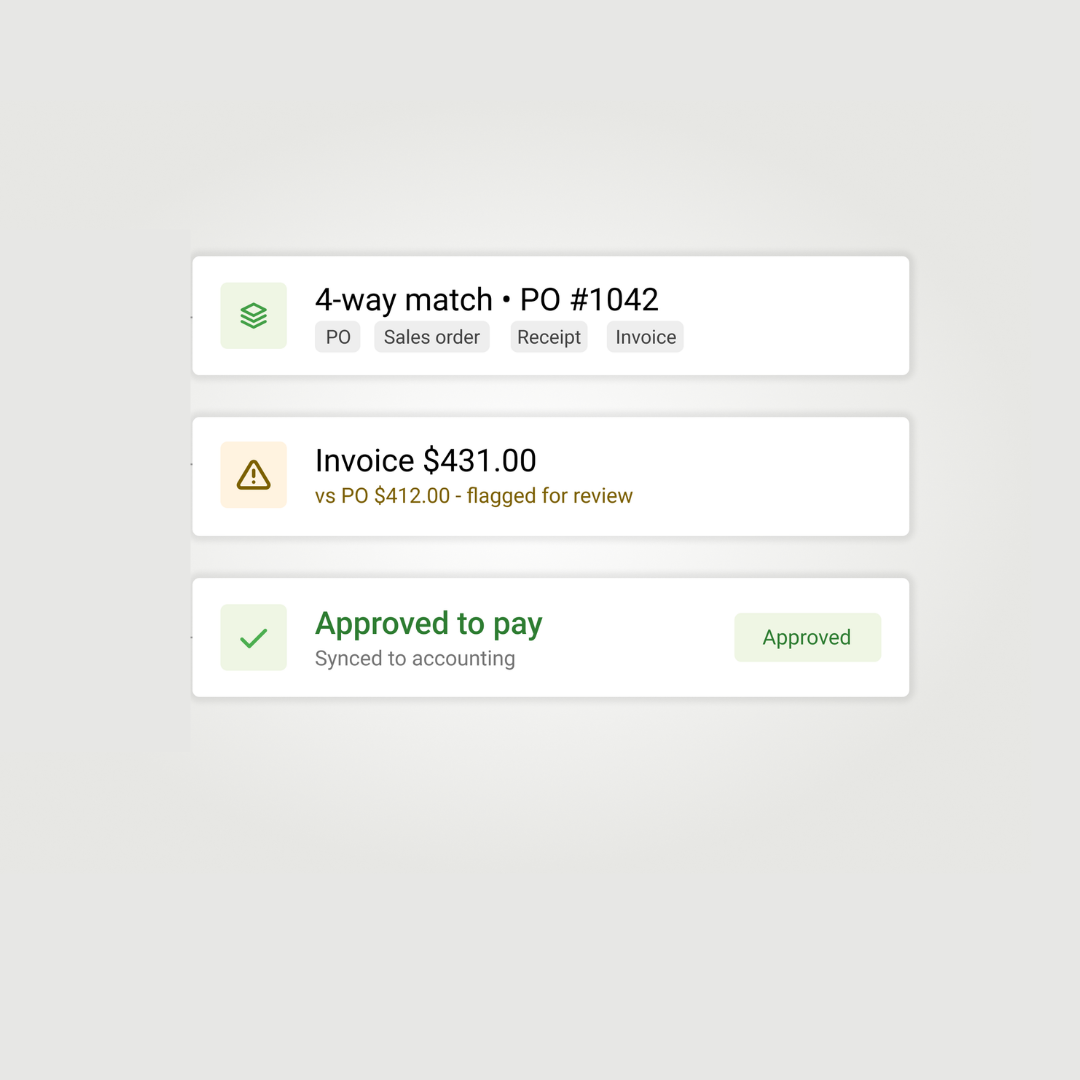
Automated 3-way matching connects your purchase orders, receiving records, and invoices in one system. When an invoice arrives, the system pulls the matching PO and receiving data automatically. It compares quantities, prices, and terms. Clean matches get approved without human review. Discrepancies get flagged with specific details: "Invoice quantity exceeds received quantity by 12 units" or "Unit price is $0.35 higher than PO."
Your team stops reviewing documents and starts resolving exceptions. That's a fundamentally different use of time.
For electrical and mechanical contractors managing material costs at scale, Remarcable's accounting integration automates this matching process. InvoiceSense cross-checks purchase orders against invoices and flags discrepancies before payment. The 3-way match happens automatically, with your team reviewing only the exceptions that need human judgment.
That's margin protection that runs in the background while your team focuses on running jobs.
Connected purchasing and material operations for MEP contractors
See how contractors run procurement with Remarcable
Request a demo and we'll walk through exactly how it fits your team's workflow.