"100 more monkey butts": What the office loses in translation
Field crews name every part on the job site, and the catalog files it under something else.
Key Takeaways
- Every trade has its own names for things. The trouble starts when a name has to go on a purchase order.
- Part names are the ones that leave the job site. Slang for people and tools stays with the crew.
- Industry standards were written by manufacturers. They don’t cover a term a crew started using last spring.
- Write down the translations your team already makes. It’s an afternoon of work, and the list still works when someone’s on vacation.
- Confirm parts by sight, and track what comes back wrong. When the wrong item shows up, the problem was the name.
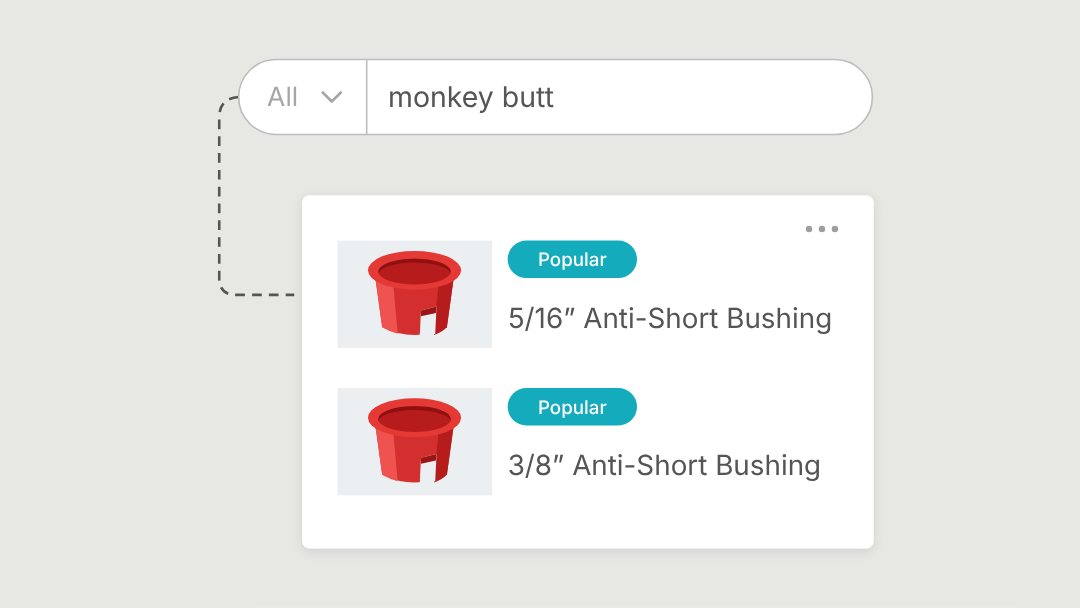
An apprentice puts in a request for 100 more monkey butts. Nobody standing on the job site is confused. The crew knows the part, and so does the foreman. The request only stops making sense once it reaches a catalog, where that same part is filed under a name a manufacturer chose. Every trade names everything, and the names work right up to the moment a name has to become a purchase order.
A purchasing agent closes that gap, usually from memory, usually while doing three other things. That part of the job never gets written down.
At Lighthouse Electric, it happens in the open, with a picture: "A specific part on the job, I'm able to actually identify it on site with them on my iPad to show them, 'Is this the part that you're in question right now that you would like me to order?'"
Field slang is documented, but only part names have to travel
The trades have recorded plenty of this vocabulary. Georgia Underground, a distributor, publishes a lineman's slang dictionary running to roughly 50 terms: a shovel is a banjo, a hammer is a persuader, an adjustable wrench is a knuckle buster, and the helper carrying them is a gopher.
The dictionary does not sort the names, but they fall into three groups, and only one of the three regularly leaves the job site.
The same dictionary defines them. A kettle is a transformer, booger wire is neutral wire, and a chicken wing is a steel insulator standoff. None of those three words appears on an invoice.
The industry already built the dictionary
Manufacturers and distributors spent decades on the naming problem, and they solved a large part of it. ETIM, the international classification standard for technical products, carries a synonym layer for exactly this reason: "whether someone searches using a technical term or a more everyday expression, they'll be guided to the correct class." The class "Anchor Bolt" alone carries 17 English synonyms.
Every word in ETIM's synonym list was written from the manufacturer's side of the counter. Knowing that a crew means an anchor bolt does not tell you which anchor bolt, in what size, from which branch, at what price, against which phase code. And a term one crew started using last spring is not going to a standards body.
Even the distributor publishing that lineman's dictionary says as much: "we understand that every crew has its own way of saying things."
Everyone involved already knows the vocabulary problem is real. That knowledge just never reaches the moment somebody places the order.
Three practices that close the vocabulary gap in ordering
Write down the translations your team already makes
The translation never shows up as a line item. It shows up as coordination. Christopher Seagrist, Prefab Coordinator at Morrow Meadows, describes that work: "Challenges were having to coordinate with the field a little bit more as far as specifics and hunt down which vendor slash warehouse I'm gonna be able to get certain materials from."
Start with the terms that generate the most callbacks. Use three columns: what the crew says, what the catalog calls it, and the detail the office ends up asking for anyway, which is usually a size or a spec. A list covering what a crew orders week to week is short enough to build in an afternoon, and it is the only version of this knowledge that survives a vacation.
Let the field confirm the part by sight
A picture ends a naming argument that a phone call keeps alive. Both people are looking at the same object. Lighthouse does that check one order at a time. Systems built for the field let a crew browse pictures instead of typing part numbers, on every order.
Put the picture and the spec on the same screen. A photograph settles what a part looks like; only the spec says what it is rated for. A confirmation before the order costs a minute, and a correction after delivery costs a return, a delay, and a crew waiting on material.
Judge the catalog by what shows up on the truck
Search relevance is hard to evaluate in a demo and easy to see on a loading dock. Track the orders that come back wrong for a month and sort them into wrong item, wrong size, and wrong spec. Wrong item is the naming pile, and it is the one a visual catalog is built to empty. Wrong size and wrong spec point at the catalog data.
When your crew calls it something else
The fix is a catalog that does the translating, so nobody has to do it from memory. Remarcable maps field slang across 550K+ products, so a request keeps its meaning on the way from the job site to the supplier. Search the way your crew talks, and Remarcable is built to find the right part.
The request for 100 more monkey butts was never the problem. It was a correct description of a real part, in the words used on the job site. Ask any ordering system whether it can hear that and put the right material on the truck. See how Remarcable works for the field.
Connected purchasing and material operations for MEP contractors
See how contractors run procurement with Remarcable
Request a demo and we'll walk through exactly how it fits your team's workflow.