Order by picture, not part number: How visual material ordering works for field crews
How a slang-mapping catalog solves the vocabulary gap that breaks field procurement
Key Takeaways
- Field crews order in trade language. Most procurement tools require catalog terms. Slang mapping closes that translation gap.
- Collins Electrical cut their procurement cycle from 2–3 hours to 5–10 minutes with visual ordering.
- When the field orders precisely, purchasing capacity compounds. Guarantee Electrical runs 135 POs a day with two purchasers.
A foreman needs a 3/4" compression coupling. He knows exactly what it looks like, he knows what everyone on the crew calls it, and he needs it today. What he doesn't have is the manufacturer SKU. That's where the ordering process often stalls.
The phone call to purchasing. The description that doesn't quite translate. The purchasing agent has to look it up while the field waits. Sometimes the wrong part arrives anyway, because "comp coupling" doesn't map cleanly to a catalog entry without experience on both ends of the phone. That experience is becoming harder to find.
The vocabulary gap has always existed
Field crews speak in trade language. Journeymen learn part names on the job: from the foreman, from the supplier counter, from other crews. That vocabulary is specific, regional, and often disconnected from what manufacturers print on the box. A "four square box" is a four-inch square electrical box to the crew ordering it. A comp coupling is a compression coupling. EMT connector, Caddy, Unistrut. These are the names that move material on a job site.
Manufacturer SKUs are a second language, and most field workers aren't fluent in it. Experienced crews worked around this by building vocabulary over years. A veteran foreman who'd ordered the same 40 SKUs a hundred times didn't need a catalog. He just knew.
That workaround is retiring out. According to Deloitte's Engineering & Construction Outlook 2025, 41% of construction workers are expected to retire by 2031, and only 10% of current workers are under 25. The crew placing orders today is less likely to carry that embedded part-number knowledge, and the crew being trained into the role definitely isn't. Electrical Contractor magazine's 2024 Profile of the Electrical Contractor puts the hiring difficulty in numbers: 63% of electrical contractors report difficulty finding trained workers, rising to 80% for firms with 10 or more employees.
The part-number translation problem didn't disappear when experienced workers showed up. It was just absorbed by institutional memory. As that memory retires, the field needs a system that adapts to how crews actually talk, not one that makes crews adapt to it.
What slang mapping does
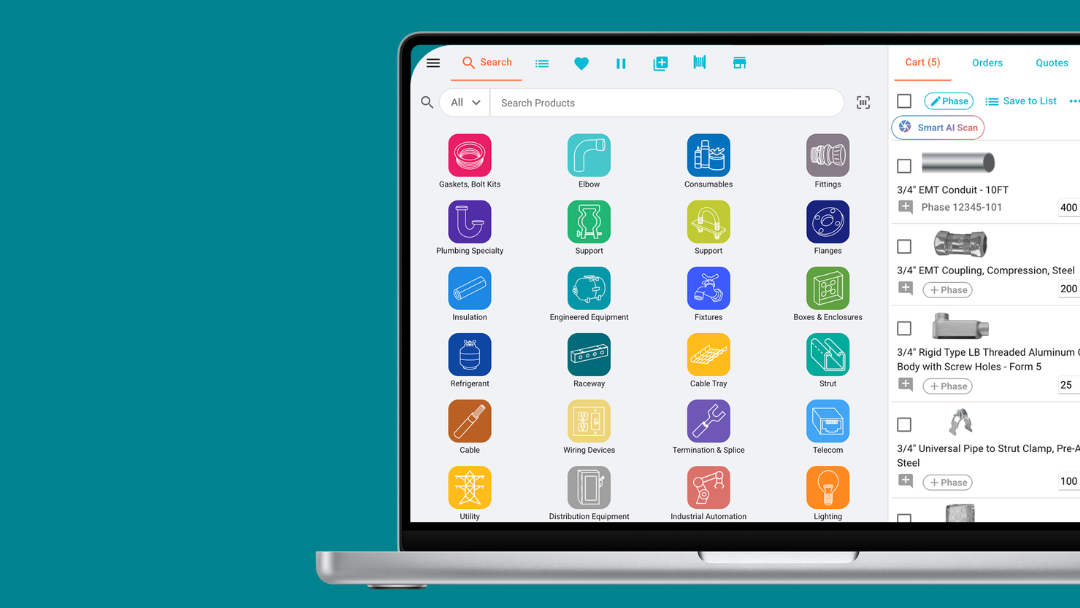
The core mechanic in visual ordering is the catalog layer underneath the image. A foreman searching "3/4 comp coupling" in Remarcable doesn't need to know the manufacturer part number. The catalog maps the field term to the correct SKU. That disambiguation is doing real work.
Christopher Seagrist, Prefab Coordinator at Morrow Meadows, describes how it works from the field side: "You can be pretty vague. You can put in slang terms that the field uses and it knows slang terms and it brings up items based off of what you're trying to look for. It tries to be helpful on that aspect so you don't have to be all the way down pinpoint to exactly what you're looking for to find it."
This is different from generic keyword search. Global search returns results based on what's in the product title or description, which is useful when you know how the manufacturer names the part but less useful when you don't. Slang mapping narrows results by connecting field vocabulary to trade-specific catalog entries. A search for "comp coupling" doesn't surface everything in the conduit fittings category; it surfaces compression couplings and confirms the spec before the order goes through.
The image is the second confirmation layer. Electrical construction materials don't always differentiate by thumbnail. A compression coupling and a gland connector can look similar at catalog size. The slang-mapped search gets the crew to the right category; the image confirms the right spec. Together they replace the call to purchasing.
The Remarcable catalog covers 550,000+ products with this slang-mapping layer built in, covering the breadth of what field crews actually order across the electrical trade. Fred Robinson, a Project Manager at Copper State with 25 years in the industry, put it plainly: "They can work from pictorial catalog. Any product within the electrical industry is there. No other application comes with such a vast catalog."
What the ordering flow looks like
The sequence from "I need a part" to "order confirmed" looks like this in practice:
The foreman opens the app on a phone or tablet, the same device they're already carrying on site. They type what they'd say to anyone on the crew: "3/4 comp coupling," "Caddy strut," "1/2 EMT connector." The search returns matching products with images and spec details. They tap the image that matches what they're holding or looking at in the wall. Spec details confirm the match: size, material, connector type. The item goes into the cart with quantity. The order routes to purchasing for PO creation and to the supplier for fulfillment.
No phone call to the office. No round-trip where purchasing has to call back to confirm which coupling, which size, whether they need connectors. The field communicates exactly what they want, and purchasing receives an order that's already confirmed.
Jessica Nascusa, Senior Purchasing Agent at Morrow Meadows with nearly a decade in the role, describes what the old process cost: "There's a translation issue of they want a certain part, if you don't have those exact numbers, it's sometimes hard to remember everything to give to the vendor, and they're thinking of a different part."
That translation step is the interruption loop: the field places an incomplete request, purchasing interprets it, sometimes incorrectly, the wrong part arrives, the field calls back. With 79% of the electrical contractor workforce working on-site, the system built for the office is serving the wrong room.
When Collins Electrical moved to visual ordering, their procurement cycle dropped from 2-3 hours to 5-10 minutes.
Why the field uses it
Field crews don't use systems because the system is technically sound. They use systems that fit how they work on site, and adoption is the measure of whether that fit exists.
Paynecrest Electric's field teams put it plainly: "If you can use Amazon, you can use Remarcable." The mechanic is familiar enough that adoption doesn't require training, but the catalog is built for the trade, not a consumer storefront. The slang-mapping layer and 550,000+ products reflect how electrical crews actually work.
Guarantee Electrical described the field reaction when they rolled it out: "Rolling out software for the guys in the field is a big deal. It's usually a challenge if they have to learn something new. It's not easy. But this, we put it in their hands and they were like, 'Oh, I like this. I can, you mean I can just do this?' And they just started pushing buttons and fell in love with it."
Interstates brought 230 job site supervisors onto Remarcable and saw the same pattern. Steven Druin, Interstates' SVP of Technology, describes what broke in the old system: "They wanted to order something like a four square box into our purchasing department and that opens the door for 30 more questions. How many, what size knockouts do you need, what kind of connectors do you need in the box, do you need brackets, what type of brackets. Creates so much more communication than is necessary and slows down the process."
When a crew member orders a four square box through the visual catalog, they select the correct knockouts, connectors, and bracket type during the ordering step. Purchasing receives a complete, confirmed order. Interstates also standardized 12,000 SKUs for prefab ordering through the system, so field vocabulary is consistent across locations and crew changes don't introduce new translation errors.
The workforce math
Electrical construction schedules have compressed, and the crews executing those schedules are turning over faster than before. That's not a complaint about less-tenured workers. It's a description of the structural conditions under which field ordering happens today.
A purchasing manager at a well-run shop could argue the answer is better training: teach field crews part numbers, standardize requisition forms, build the vocabulary. For a stable crew on a long-term project, that works. For a firm running six job sites with high field turnover, it doesn't stick. The training investment has to repeat with each new hire, and the first week on site is not the week anyone is learning manufacturer SKUs.
Construction workers spend 5.5 hours per week searching for product data, according to FMI's construction productivity research. That's one of the clearest measures of what the translation problem costs in labor: time on site spent hunting rather than installing. A journeyman who just started their second week on the job can search the way they'd describe the part to a foreman and get to the right catalog entry. The system does the vocabulary work; the crew focuses on the install.
80% of electrical contractors cite availability as a top-three factor in brand selection, according to the 2024 EC Profile. When the confirmation loop takes hours, crews default to whatever they can source fast, sometimes bypassing the procurement process entirely. Visual ordering shortens that loop enough that the correct part, sourced through the preferred supplier relationship, is still the fastest path.
What it means for purchasing
The foreman experience is the entry point, but the purchasing manager's day changes too. When field crews search and confirm by picture before submitting, the requests that arrive at purchasing are specific and matched to catalog entries. No interpretation step. No callback to confirm which fitting, which size, which gauge.
Collins Electrical's purchasing team described the before state directly: "We were spending more time managing the procurement process than actually procuring materials." The interruption loop (field request, purchasing interpretation, callback, reorder) was eating the work day.
With a visual catalog of 550,000+ products available to field crews and slang mapping handling the vocabulary translation, the purchasing team receives orders that are already confirmed. The work shifts from translation and interpretation to execution: placing POs, managing supplier relationships, tracking delivery.
That shift scales. Guarantee Electrical processed 135 purchase orders in a single day with two purchasers. Remove the translation requirement, and the purchasing team gets their capacity back.
The mechanic is the differentiator
Every major field ordering platform describes visual ordering as a capability. What's less documented is the vocabulary layer that makes it work for electrical construction specifically. Consumer visual search works because products are standardized. A blue widget is called a blue widget by every manufacturer, and the image confirms it. Electrical construction materials are standardized in spec, but the field names for them vary by region, by trade, by crew. The image search confirms the spec. The slang layer closes the vocabulary gap between what the crew says and what the catalog expects.
Slang mapping surfaces the right part based on how the crew describes it, not how the manufacturer catalogs it.
That's the mechanic. Search in field language, confirm by picture, submit a complete order. The catalog does the translation. Purchasing gets a request it can act on. The right part arrives on site.
See how field ordering works at Remarcable.com/solutions/field.
Connected purchasing and material operations for MEP contractors
See how contractors run procurement with Remarcable
Request a demo and we'll walk through exactly how it fits your team's workflow.