Your material-buying process is really a cash flow strategy
Trade contractors front materials 56 days before GC payment arrives — and most don't have a live view of what they've committed
.png)
Key Takeaways
- 75% of subcontractors front materials before GC payment; the average wait is 56 days. GCs estimate 30.
- 81% of subcontractors have supplier terms shorter than their days sales outstanding. The funding gap is the default condition.
- Subcontractors who factor working capital into bids report 24% profit margins versus 17% for those who don't.
Every material order a trade contractor places is a financing decision. Most are made without a financial lens.
The moment procurement became its own department, it got separated from the finance conversation. Purchasing handles materials; accounting handles cash. The result is that a CFO or owner sees the cash impact of procurement decisions only when invoices stack up at AP close, after the decisions are already made. By then, the exposure is locked in.
This isn't an operational failure. The structural mismatch between how trade contractors buy materials and when they get paid is baked into how the industry works, and it creates a cash flow problem that begins upstream of every invoice.
The gap is bigger than GCs think it is
Billd, a construction financing company, surveyed more than 800 subcontractors for its 2025 National Subcontractor Market Report. The profile of respondents matters: 88% had been in business ten or more years. These aren't startups with cash management growing pains.
The findings are striking for how structural the problem is. 75% of subcontractors routinely pay out of pocket for materials before receiving payment from their GC. Most of them are doing this on every project, as a standard operating procedure.
The average wait from submitting a pay application to receiving payment is 56 days. GCs, when asked the same question, estimated 30 days. That 26-day perception gap is evidence that the people creating the cash timing mismatch can't see it from their side. Trade contractors can't negotiate their way out of a gap their GC doesn't believe exists.
81% of subcontractors have supplier payment terms shorter than their average days sales outstanding. That ratio means the structural funding gap is the default operating condition, not an occasional squeeze.
Why this is a finance problem, not a purchasing problem
The standard response to pay slowly in construction is downstream: tighten up lien rights, improve invoicing consistency, push for electronic payments. These are legitimate tactics. They operate after the work is done and the invoices are submitted.
Procurement operates upstream. Materials are ordered before work is installed, before invoices are submitted, and months before payment arrives. The decision to place an order (how much, from which supplier, on what timeline) is made without real-time visibility into what's already been committed across other jobs. A CFO reviewing cash position at month-end is looking at invoices that have already been processed. The committed cost that preceded those invoices was invisible until it landed.
This is the reframe worth sitting with: if your business is fronting materials for multiple concurrent jobs without a live view of committed spend, you're not managing procurement. You're managing cash flow events after procurement has already shaped them.
The unit cost problem inside the cash gap
The liquidity squeeze gets attention. The unit cost erosion gets less, even though it compounds directly against margin.
When trade contractors pay outside supplier terms (which 81% are structurally set up to do), there's a second cost layered on top. 45% of suppliers increase material prices for customers who pay outside terms, by an average of 11%, according to the Billd report. Only 22% of subcontractors use their payment history as a lever with suppliers.
Put the math against the margin. Construction net profit averages 5-6%. Materials represent 30-40% of total project cost. An 11% supplier price penalty applied to a material cost base of 35% of revenue doesn't reduce profit. It eliminates it.
The cash gap that looks like a liquidity problem is also degrading your unit costs, quietly, job by job, without showing up as a line item anywhere.
What financing tools do and don't fix
Construction financing products (Billd's own line among them) exist precisely to bridge the payment gap. They work. A trade contractor with access to material financing is less likely to run short while waiting on GC payment.
Financing bridges the gap. It doesn't tell you how wide the gap is, and without that visibility, the CFO can't plan around it.
A trade contractor with a credit line and no committed-cost visibility is still discovering the size of their exposure at AP close. Finance can't plan cash timing around committed spend that isn't visible until invoices land. If an unexpected project delay shifts cash timing by three weeks and procurement has committed material costs across six jobs, the CFO is managing a surprise. Visibility is the control mechanism; financing is the safety net. They're complementary layers. The piece of infrastructure missing for most trade contractors isn't access to capital. It's knowing what's been committed before the invoices arrive to prove it.
Procurement decisions as financial decisions
The Billd data includes a cohort comparison worth noting. Subcontractors using integrated financial tools and factoring working capital costs into their bids reported 24% profit margins, compared to 17% for those who don't (a 41% differential in profitability between the two cohorts).
What separates those two cohorts isn't a better credit line. It is financial discipline applied upstream: treating the cost of fronting materials as a real input to project pricing and cash planning, rather than absorbing it as a hidden drag discovered at close.
The procurement decisions that are happening before a single invoice lands are shaping margin. Knowing what's been committed, in real time, across every job, is what changes a surprise into a managed variable.
What committed-cost visibility changes
Guarantee Electrical buys $200M in material annually. Their team was previously spot-checking invoices to catch pricing errors, a process their own purchasers described as "not a good check and balance" given the volume. With that scale, catching price discrepancies after payment means margin has already walked out the door.
Material procurement with real-time price visibility changes when finance enters the picture. Quote comparison, automated PO entry, and real-time price tracking shift the financial control point from AP close to the moment of procurement. When a supplier bills above agreed pricing, the discrepancy is caught automatically before it becomes a payment.
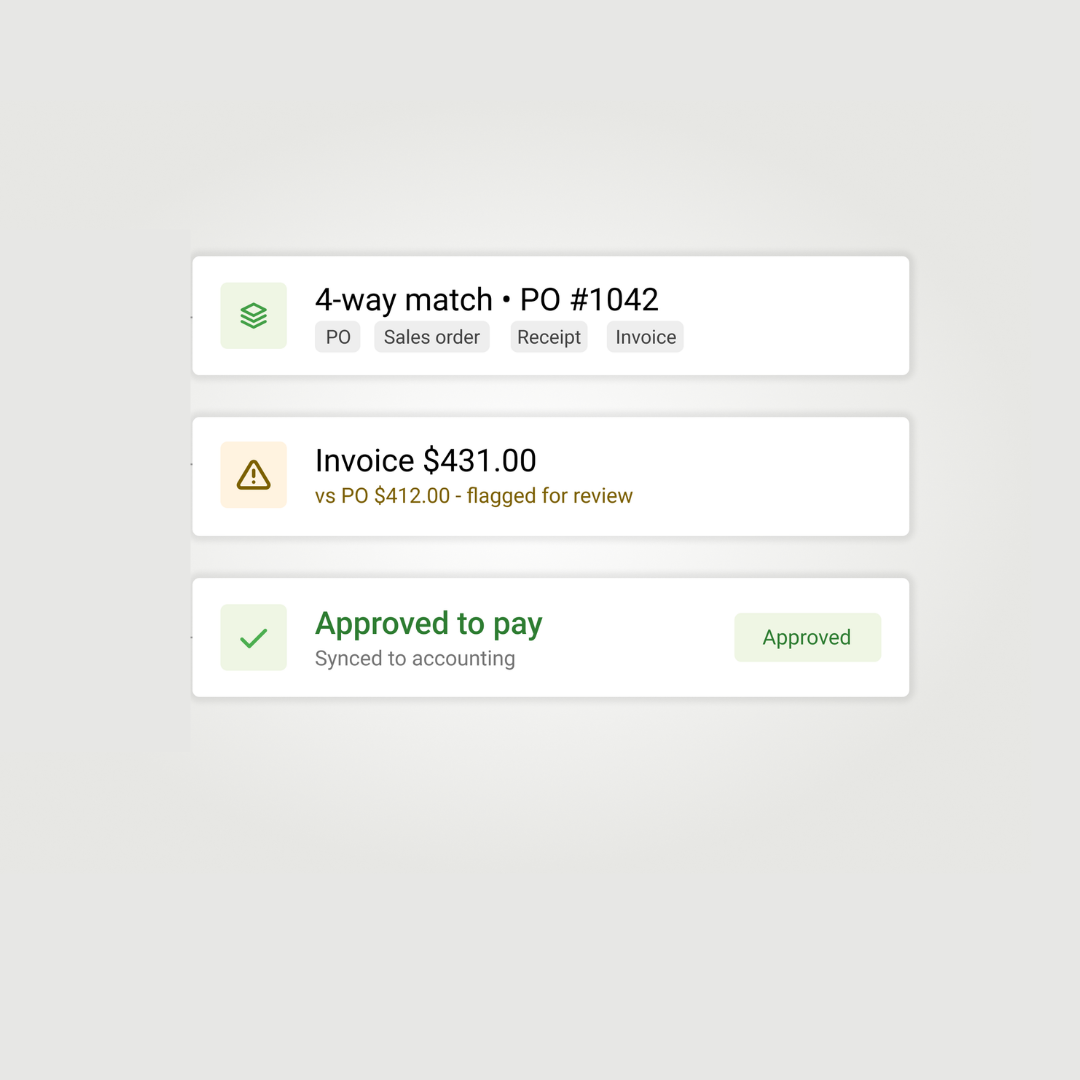
Committed cost visibility before invoices arrive is the mechanism that closes the gap for the CFO. Real-time order status across active jobs means committed spend is visible as it's incurred, weeks before the invoice confirms it. The 4-way match (PO, sales order, proof of receipt, invoice) eliminates invoice surprises. With 35+ accounting and ERP integrations, committed cost flows to your system of record in real time, not at month-end AP close.
Guarantee Electrical named the scale directly: "We started paying more attention to how we handle materials when we discovered that 40% of people's time is all about material management. In addition to that, we're buying $200 million of material a year. So the more that we can save on that, obviously the better it is for our company." See how Guarantee Electrical controls $200M in material spend.
The cash flow problem has a visibility solution
43% of subcontractors lack the working capital to handle unexpected costs, and 1 in 3 pull from personal or retirement savings to cover cash shortfalls from slow GC payment. These operators aren't undercapitalized by nature. They're absorbing the downstream consequences of a structural payment mismatch, compounded by not knowing what their committed costs are until invoices confirm them.
No procurement tool changes when GCs pay. That mismatch is structural. What changes is whether a finance team is managing known committed exposure or discovering it at AP close.
A procurement system that surfaces committed cost to finance in real time is a cash flow control instrument. The chaos doesn't live in the purchase orders. It lives in the gap between when costs are committed and when finance can see them. Close that gap and committed exposure becomes something a CFO can plan against.
See how Remarcable gives you visibility into committed costs
All Billd statistics cited from the Billd 2025 National Subcontractor Market Report, a vendor-sponsored survey of 800+ subcontractors. Billd is a construction financing company. The 41% profitability differential reflects a cohort comparison within the Billd report, not an industry average.
Connected purchasing and material operations for MEP contractors
See how contractors run procurement with Remarcable
Request a demo and we'll walk through exactly how it fits your team's workflow.