Procure to pay in construction: how the cycle works from requisition to payment
The seven steps between a crew needing material and a distributor getting paid, and what construction adds to each one.

Key Takeaways
- Procure to pay is the full cycle from someone asking for material through to the distributor being paid, covering requisition, approval, purchase order, receiving, invoice matching, payment, and cost allocation.
- The generic version of this cycle assumes a purchase order gets fulfilled once, completely, to a receiving dock, against a cost center. Construction breaks all four of those assumptions on an ordinary week.
- What construction adds: a job and phase code attached at the moment of request, committed cost visible before the invoice arrives, a match that survives partial deliveries, and pricing that expires.
- The cycle exists at every contractor whether or not anyone has named it. What changes with a connected system is how many hands the information passes through unchanged.
A request comes off a job site on a Tuesday morning and lands in purchasing already carrying the job number and the phase code it belongs to. The purchaser checks it against a distributor price file that updated overnight, approves it inside the threshold set for that job, and a purchase order goes out before lunch. The committed cost appears in the project's numbers that afternoon, weeks before anybody sees a bill. Material arrives Thursday in two shipments instead of one, both get recorded against the same order, and when the invoice comes in the following month the price, the quantity, and the receipt all line up, so it gets paid without anyone opening a folder to go looking.
Those steps are the procure-to-pay cycle, and every contractor already runs some version of it whether or not anyone in the building calls it that, and whether or not there is software involved. What follows is each step in order, what construction adds that the standard version of this cycle leaves out, and what to look for in a system that has to carry it.
What is procure to pay?
Procure to pay is the end-to-end process of requesting material, buying it, receiving it, and paying for it, with the record of each step connected to the ones on either side. Finance teams shortened it to P2P somewhere along the way, and the term shows up more often in corporate procurement than on a job site, though the cycle it names is the one a purchasing manager runs every day.
The steps are the same everywhere: someone identifies a need, a requisition gets raised and approved, a purchase order goes to a supplier, the goods arrive and get received, an invoice comes in and gets matched against the order and the receipt, and payment goes out. What differs between industries is what each step has to carry, and construction asks more of every one of them than a corporate office does. The tooling built to run this cycle is covered in construction procurement software, which is the category question rather than the process one.
Cycle time is the number that makes the case for connecting the steps. Procurement across industries averages 40.5 days from requisition to fulfillment, and construction schedules do not have 40 days to give back. Each handoff in the cycle where information gets re-keyed instead of carried forward is a place where that number grows.
Procure to pay compared with accounts payable and source to pay
Three terms get used interchangeably and describe different spans of the same work, which matter when a vendor tells you their product covers one of them.
Accounts payable
Accounts payable is a step inside procure to pay rather than a parallel process. AP owns what happens once an invoice arrives: validating it, matching it against the order and the receipt, coding it, and issuing payment. It is the back half of the cycle, and an AP automation tool that starts at the invoice inherits whatever quality the front half produced. A wrong phase code entered at requisition is still wrong when AP receives it, and by then it costs more to fix it. That handoff is worth understanding from both sides, which is the subject of what accounts payable needs from procurement.
Source to pay
Source to pay wraps a wider loop around the same cycle by adding everything that happens before a requisition exists: market analysis, supplier discovery, RFQs, negotiation, and contracting. In construction much of that work happens at the estimating and buyout stage, and it runs on relationships with distributors that were established years before the job was bid. Source to pay is the bigger circle, procure to pay is the operational one that turns every day.
Where ERP sits
ERP is the financial system of record and it owns the ledger, job costing, billing, and payroll. CMiC-sponsored research from Dodge Construction Network found that 75% of general contractors use ERP systems, a figure worth reading with its scope in mind, since it counts general contractors specifically. Procurement feeds ERP rather than competing with it, handing over a coded transaction once the cycle has verified it.
The complete procure-to-pay cycle, step by step
Seven steps, each one a handoff where the record either carries forward intact or gets rebuilt by hand.
1. A need gets identified
Somebody discovers that work cannot continue without material, which on a job site usually means a foreman looking at a wall and a drawing at the same time. The information that matters at this moment is what is needed, how much, which job, which phase, and when it needs to be there. Anything not captured here gets reconstructed later by someone with less context, and how material requests flow from field to supplier traces where that reconstruction usually goes wrong.
2. A requisition gets raised
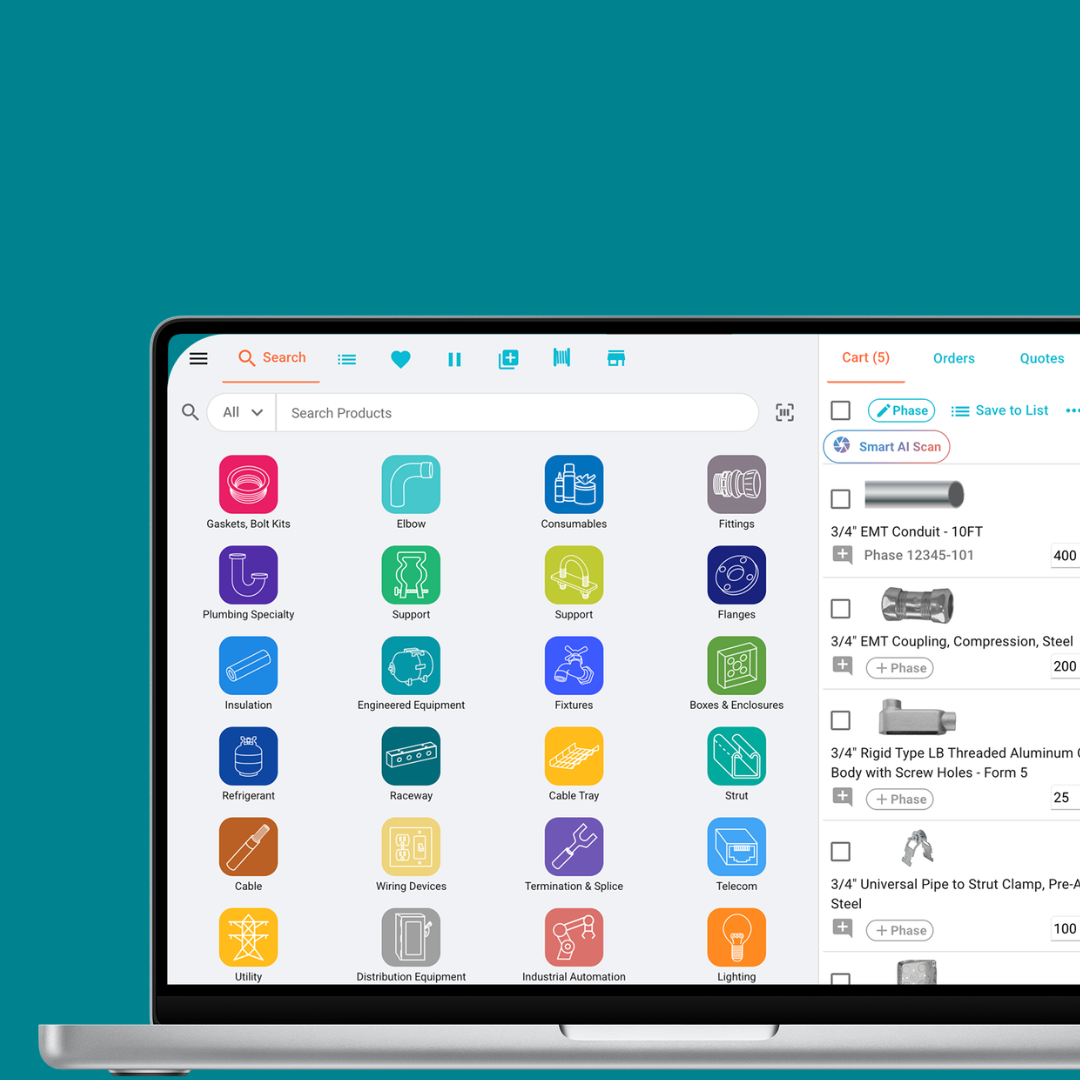
The request becomes a formal record, which in a corporate setting means a form with a cost center on it, while in construction the record has to carry a job and a phase code, which is the detail that determines whether the cost can be allocated later without someone guessing. The practical constraint is that the person raising it is standing on a job site, so ordering from the job site has to work on a phone rather than requiring a return to the trailer or a call to the office.
3. Approval routes it
Somebody with authority confirms the spend, and approval thresholds in construction tend to be set per job and per role rather than by department, because a superintendent running a $12M project has different latitude than a foreman on a service call. Routing that takes days rather than minutes is the point where crews start calling distributors directly to keep the work moving.
4. A purchase order goes to the supplier
The PO commits the money and tells the distributor what to ship, where, and when. A construction PO carries the job and the phase alongside the line items, and it goes to a distributor whose pricing may be job-specific and time-limited. What separates it from a generic purchase order is covered in construction purchase order software, and the sourcing decision behind it depends on live price and availability feeds rather than a price file from last quarter. Supplier choice has also become less stable, with 32% of construction firms switching suppliers amid volatility since 2020.
5. Material gets received
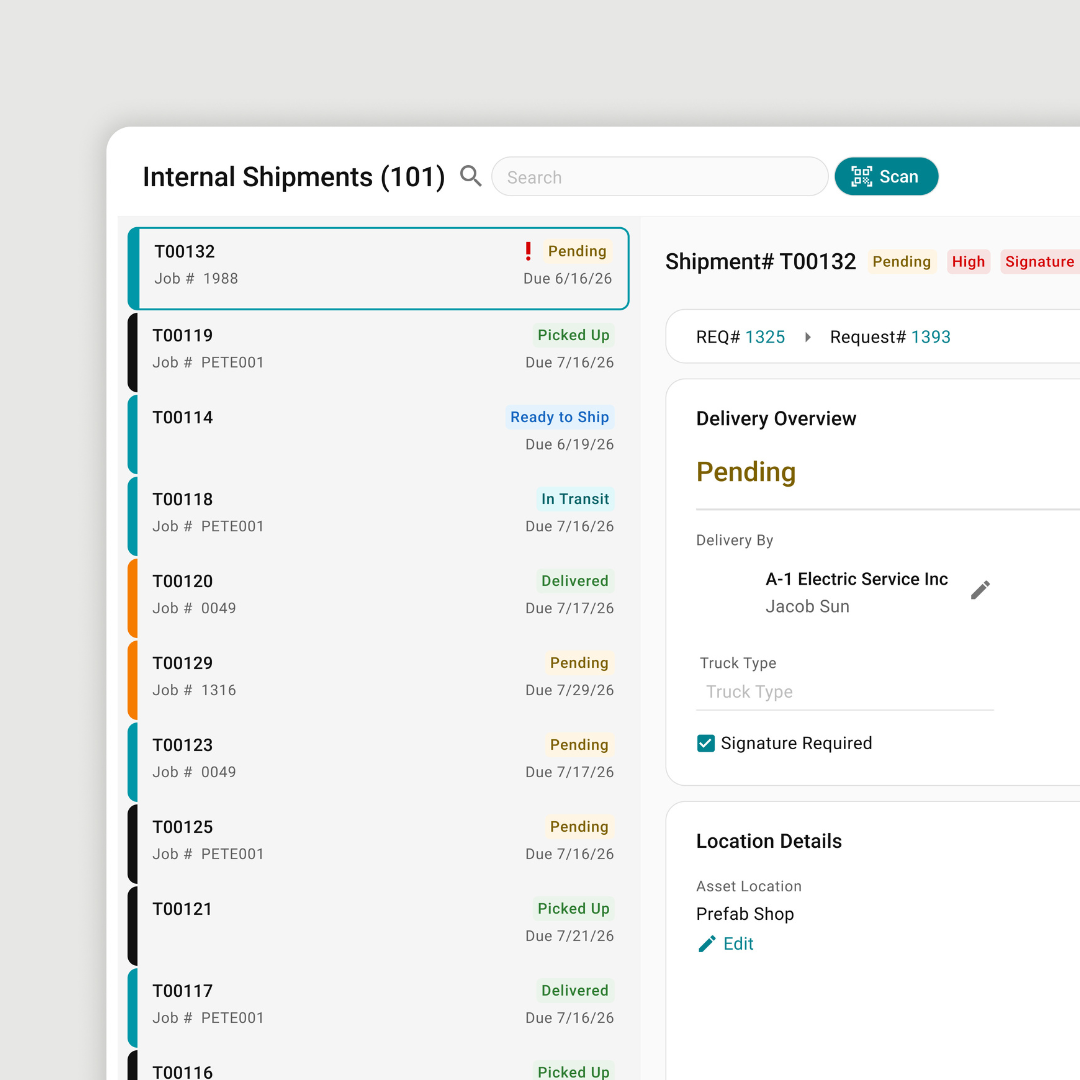
The goods arrive and somebody records what actually showed up. Corporate receiving happens at a dock with a person whose job is receiving, while construction receiving happens at a job site with a foreman who has a crew waiting on him, which is why this step is the one most often skipped entirely. Tracking material deliveries is what keeps the middle of the cycle from going dark.
6. The invoice gets matched
The distributor bills, and somebody confirms the price matches what was quoted, the quantity matches what arrived, and the item matches what was ordered. Three-way matching compares the purchase order, the receipt, and the invoice, and it is the control that catches overcharges before they get paid rather than after. Done by hand at volume, checking takes longer than approving, and the math wins. Remarcable has 4-way match which cross references the PO, receipt, invoice and the Sales Order.
7. Payment goes out and the cost lands
Payment gets released on terms, and the verified transaction passes to accounting coded to the job and phase it belongs to. That final handoff is where the cycle either closes cleanly or leaves a reconciliation problem for month end, and procurement-to-accounting integration covers how it works when it works.
What construction adds to the cycle
The seven steps above describe procure to pay in any industry, and the generic version of them assumes a purchase order gets fulfilled once, completely, to a receiving dock, against a cost center.A contractor violates all four of those assumptions in a normal week without anyone treating it as exceptional.
Four additions matter enough to change what a system has to do.
A job and a phase, attached at the request. Corporate procurement allocates to a cost center that does not change. Construction allocates to a job and a phase within that job, and the code has to ride along from the moment somebody asks for the material. Assigning it afterward means somebody is reconstructing intent from a description, which is where miscoding happens and where job cost reports start disagreeing with reality.
Committed cost. The money is spent the moment the purchase order is issued, even though nothing has been received and nothing has been billed. A project manager needs that number to manage a forecast at completion, and a cycle that only records actuals tells them about a problem several weeks after it stopped being fixable. Generic procure to pay has no equivalent concept because a corporate cost center is not managed to a forecast the same way.
A match that survives reality. One order becomes three deliveries across two weeks, some of it lands on the wrong floor, and the invoice covers only part of it. A matching process that requires one PO to equal one delivery to equal one invoice fails constantly under those conditions, and the failures get resolved by someone manually, which is the expensive path. Poor data and miscommunication already cause 52% of rework, part of roughly $65 billion spent on rework annually in the United States.
Pricing that expires. Distributor quotes are job-specific and time-limited, and material prices rose 4.2% on average in 2025, so the gap between when a job is bid and when the material is bought carries real exposure. That pressure is why 41% of firms accelerated material purchases after winning contracts, and why buying early creates a second problem in the form of material sitting on a site getting damaged or buried. Hold-for-release resolves that tension by locking in prices at purchase while the distributor keeps the material until the site is ready.
Retainage belongs on the list as well, though it sits more heavily on a general contractor's payment cycle than on a trade contractor buying from a distributor. Payment terms that hold back a percentage against completion are a construction-specific wrinkle the corporate cycle does not contemplate.
Two trades carry most of this volume, since electrical contractors did $249.2 billion in receipts and plumbing, heating, and air-conditioning contractors did $297.6 billion in the 2022 Economic Census, and because they self-perform installation rather than subcontracting it, material moves through this cycle as their largest cost outside labor.
Benefits of a connected procure-to-pay cycle
More volume through the same team. Capacity is the clearest measure of whether the cycle is working, and Guarantee Electric runs roughly 135 orders a day with two purchasers against $200 million in annual material spend. Those numbers depend on the record carrying forward rather than being rebuilt at every handoff.
Errors caught before they cost anything. A match that runs automatically catches a price discrepancy while it is still a question rather than a payment, and material that arrives correctly the first time removes the rework it would otherwise cause.
Cost visibility with time left to act. Committed costs appearing at the time of purchase order rather than the invoice give a project manager weeks of warning instead of a surprise at closeout.
Working capital that stays put. Duplicate orders, expedited freight, and material bought twice because nobody could see the first order all tie up cash that the business needs elsewhere.
A closing process that stops being an event. When coding happens during the original request and the match runs continuously, month end becomes a report rather than a week of reconciliation.
Where the cycle breaks
The field routes around it. When the official path is slower than calling the distributor, crews call the distributor, which produces spend with no purchase order, no committed cost, and an invoice nobody can match to anything. The cause is a process that asks a foreman to work in catalog numbers and wait on an approval, not a foreman who ignored the rules.
The match fails on partial deliveries. Split shipments and job-site receiving break a one-to-one match, and the exceptions pile up until somebody clears them manually. Volume makes this worse rather than better.
The same information gets typed three times. Re-entry between the request, the purchase order, and the accounting system is where hours disappear and errors enter, and six disconnected systems trace what that pattern actually costs.
Approval becomes the bottleneck. Thresholds set too low or routed to people who are on job sites turn a two-minute decision into a two-day delay.
Volume outgrows the team quietly. Purchasing capacity degrades slowly and then fails in a week, which is the pattern when a purchasing team cannot keep up with growth.
How automation changes the cycle
Automation earns its place at the steps where a person is doing something a system can verify faster and more consistently, which in this cycle means approvals, matching, and coding.
Approvals move from a person chasing a signature to a rule that routes by job, role, and threshold, so that routine spends clear immediately and the exceptions get attention. Matching moves from a clerk comparing three documents to a check that runs on every invoice and surfaces only the discrepancies. Coding stops being a translation step because the job and phase were attached at the request. What that adds up to is covered in automating procurement in construction.
Remarcable Intelligence handles the repetitive judgment inside those steps: invoice matching that flags a price discrepancy before payment, smart scan for turning a document into a record, auto restocking against consumption patterns, smart recommendations, and AI quote and invoice processing. Every output has a human review step and the contractor sets the guardrails, because a cycle that pays invoices without anyone looking is a different kind of problem.
What to look for in a procure-to-pay system
Where does the cycle start? If it starts at the purchase order, the front half is still running on phone calls and the system is an AP tool wearing a procurement label. Ask to see a request originate on a job site.
Does the job and phase code travel with the record? Ask to follow one transaction from request to general ledger entry and watch whether anybody retypes the code.
Does committed cost appear at the purchase order? If the answer involves a report that runs later, the number is not doing the job a project manager needs it to do.
What happens to a partial delivery? Have the vendor demonstrate one order, two deliveries, one invoice covering part of it. This is the question that separates systems built for construction from systems adapted for it.
How does it handle a quote that expires? Job-specific pricing with a date on it is normal in this industry and unusual outside it.
Does it feed the accounting system already in place? You want a named integration with the exact system in use, and anything hinting at replacing the ERP deserves a hard second look.
Connected procure to pay for electrical and mechanical contractors
Remarcable runs the whole cycle in one system, built for electrical and mechanical contractors by people who ran purchasing and managed jobs. A foreman orders by picture from the job site and the request arrives carrying its job and phase. Purchasing sources against live pricing from 450+ integrated suppliers. Hold-for-release locks pricing while the distributor keeps the material until the site is ready. A 4-way match compares the purchase order, the sales order, the proof of receipt, and the invoice, which catches what a three-way match cannot see. Then the coded transaction lands in the accounting system already in place.
Collins Electrical cut its procurement cycle from two or three hours down to minutes after moving off a manual process, and more than 40% of the top 50 electrical contractors run on the platform.
Every part. Every team. Every order. Finally connected.
See how contractors run procure to pay with Remarcable.
Frequently asked questions
What are the steps in the procure-to-pay cycle?
Seven steps: identifying a need, raising a requisition, approving it, issuing a purchase order, receiving the material, matching the invoice against the order and receipt, and paying while allocating the cost. Some publishers split these into as many as nine, describing the same actions.
What is the difference between procure to pay and accounts payable?
Accounts payable is a stage inside procure to pay rather than a separate process. AP begins when an invoice arrives and covers validation, matching, coding, and payment. Procure to pay starts earlier, at the moment somebody asks for material, and includes everything AP inherits.
What is the difference between source to pay and procure to pay?
Source to pay includes supplier discovery, RFQs, negotiation, and contracting before any requisition exists. Procure to pay is the operational cycle that runs daily once suppliers are in place. In construction, most sourcing work happens during estimating and buyout.
What is an example of a procure-to-pay process?
A crew needs material, a foreman raises a request carrying the job and phase, a purchaser approves and issues a purchase order to a distributor, the material arrives at the site and gets recorded, the invoice is matched against the order and receipt, and payment goes out with the cost allocated to the job.
Why is procure to pay different in construction?
The cost has to carry a job and phase from the moment of request, committed cost has to be visible when the order is placed rather than when the bill arrives, deliveries arrive partially in separate shipments and at job sites rather than one complete shipment at a dock, and distributor pricing is job-specific with an expiry date.
Connected purchasing and material operations for MEP contractors
See how contractors run procurement with Remarcable
Request a demo and we'll walk through exactly how it fits your team's workflow.