How to Choose Construction Inventory Management Software
How to evaluate construction inventory software and what to ask.
Every construction inventory platform demos well. Supplier integrations, mobile access, job costing, real-time visibility. The differences between platforms show up after implementation, not before it. Six months into implementation is when you find out that the supplier connections are CSV exports, the mobile app chokes on job-site cell coverage, and the accounting sync requires the same manual reconciliation you were trying to eliminate.
When materials represent 30-40% of total project costs, picking the wrong system locks in blind spots across every job, every warehouse, and every truck for years. This guide covers what to evaluate, what to prioritize based on company size, and what questions to ask vendors before you sign anything.
ERP inventory modules vs dedicated material management platforms
Most contractors start their search by looking at what their existing systems offer. Procore, Viewpoint Vista, Sage 300, and similar ERPs all include inventory modules. These work for tracking materials at a high level but they were built to manage projects, not procurement workflows. The two are very different.
Dedicated construction material management platforms like Remarcable, Kojo, and others are built around the purchasing and inventory cycles specifically. The differences matter for trade contractors:
ERPs handle job costing well because that is what they were built for. But if the purchasing team is still re-keying orders, chasing delivery status by phone, and manually reconciling invoices, the ERP's inventory module is not doing the work that an electrical contracting company requires.. The gap is in procurement-to-accounting integration, where material costs need to flow from the purchase order through receiving and into job cost codes without manual re-entry. Steven Druin, SVP of Technology at Interstates, has seen both sides: "A lot of companies say they integrate... when they truly don't, they're importing and exporting CSVs with minimal data flow at best."
The question is whether you need better visibility into what you already track, or whether you need to fix the procurement workflow that feeds your inventory data in the first place. For most mid-market trade contractors still running spreadsheets, it is the latter.
What separates construction inventory software from generic platforms
General inventory platforms assume one or two locations, predictable demand, and standardized SKUs. A contractor running 15 active jobs has materials distributed across job sites, a main warehouse, satellite storage, service vans, and a prefab shop. Materials arrive on different schedules from different suppliers, get consumed at rates that change weekly, and need to be tracked against specific job cost codes.
Three capabilities separate construction-grade inventory software from generic alternatives:
Multi-location visibility. The system needs to show inventory across every location you operate, including temporary job site storage, service vans and prefab staging areas. Many platforms handle a central warehouse well but treat job sites as an afterthought. The result is blind spots that lead to defensive over-ordering, tying up cash flow and filling warehouse space with materials that may not be needed for months or at all.
Supplier integration depth. When a warehouse count drops below a threshold, the system should connect directly to suppliers for pricing, availability, and ordering. The depth matters more than the number of supplier connections:
Guarantee Electrical processes 135 orders in a day with two purchasers. That volume is only possible with deep integrations, not CSV exports.
Field adoption. If the mobile app is harder to use than calling the office, the crew will call the office. 48% of construction firms cite training costs as the biggest barrier to technology adoption, but the real barrier is usability. Guarantee Electrical saw what happens when software matches the workflow: "We put it in their hands and they were like, 'Oh, I like this.' And they just started pushing buttons and fell in love with it."
For contractors with service divisions, mobile access is especially critical. Service electricians and mechanical technicians work from vans at customer sites with no office access. If they cannot check van stock and request parts from a phone, the inventory system has a gap that grows with every new maintenance contract.
What mid-market contractors should prioritize
A $75 million electrical contractor and a $500 million general contractor both need inventory software, but they need different things from it. Mid-market contractors ($50M-$250M) win through specialization and relationships, not scale. Their software needs to support speed and flexibility rather than compliance and governance.
Interstates brought on 230 job site supervisors and saw quick adoption because, as Jay Kelly put it, "Once they get in there and they learn to navigate it, they understand how much time it saves and allows them to receive material on site that they actually wanted."
Why documented inventory systems affect what the business is worth
For contractor owners thinking about what comes next for the business they built, documented systems directly impact what the company is worth. A buyer evaluating a contracting firm looks at two things beyond revenue and margin: how dependent the operation is on specific individuals, and how repeatable the processes are without those individuals present.
A contractor whose material processes live in spreadsheets, email threads, and the purchasing manager's memory is worth less than one with the same revenue whose inventory, procurement, and job costing run through documented, auditable systems. If the purchasing manager leaves and takes 15 years of supplier relationships with them, the acquirer inherits a business that depends on one person to function, and that risk gets priced into the offer.
For contractors not thinking about an exit, the same principle applies to growth. The processes that work at $50 million break at $150 million. Building inventory systems before growth forces the issue allows scaling the business without the chaos that comes from outgrowing spreadsheets.
Questions to ask before you buy
Every vendor claims the same features. These questions focus on operational fit.
On construction fit:
- How does your system handle inventory across job sites, not just warehouses?
- Can material costs be allocated to specific job numbers and phase codes automatically?
- Do you support service division use cases (van stock, maintenance parts, recurring orders)?
On field adoption:
- What is the typical adoption rate among field teams after 90 days?
- Does the mobile app work offline?
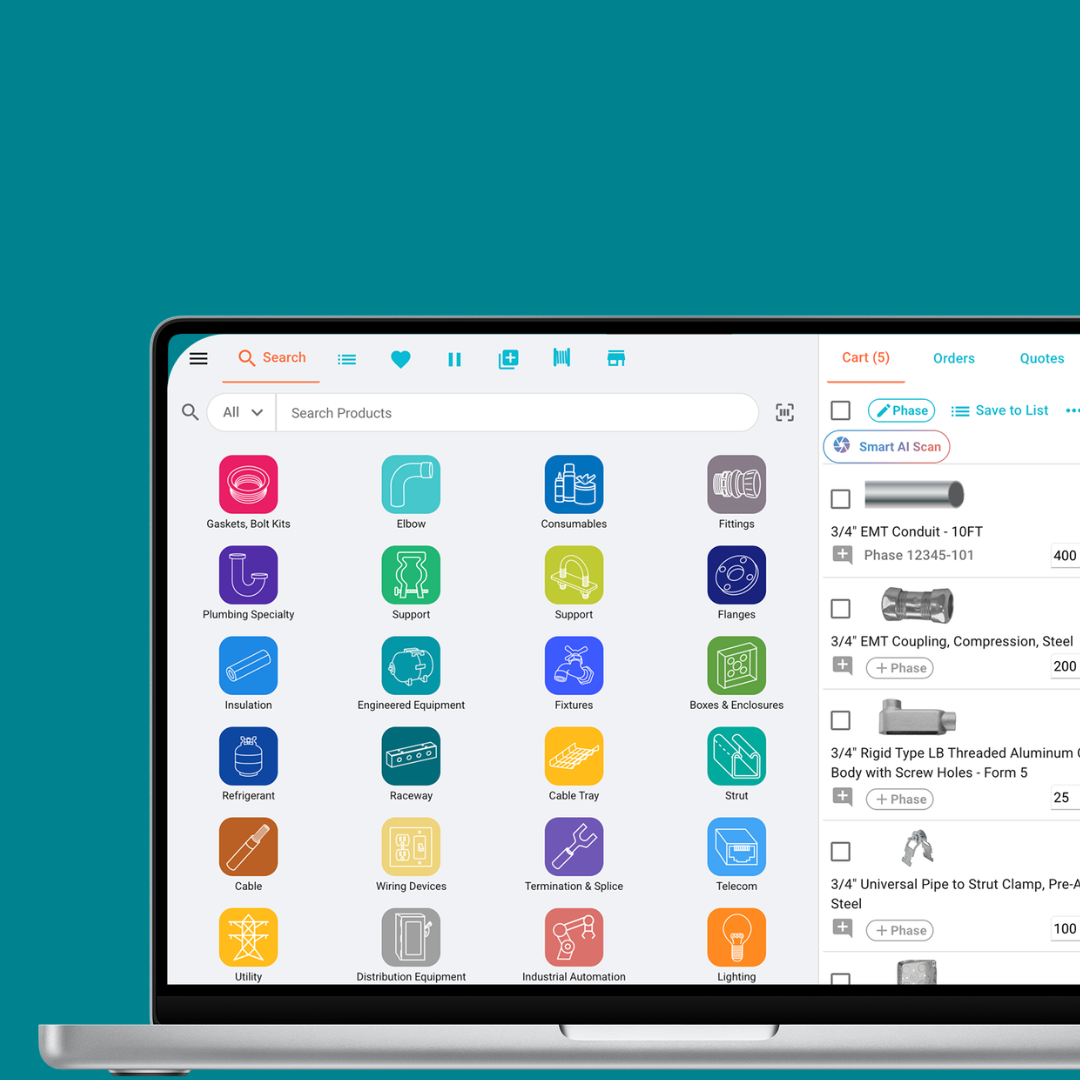
- Can field crews identify parts visually instead of searching by SKU?
On implementation:
- What is the typical timeline from contract to first real order processed?
- How do you handle the transition period when some jobs are in the new system and some are not?
On total cost:
- What is the pricing model (per user, per transaction, flat rate)?
- Are supplier integrations included or do they cost extra?
- What hidden costs have other customers encountered?
For contractors evaluating options, Remarcable connects inventory management with procurement, 450+ supplier integrations, and field ordering in a single system built for electrical and mechanical contractors. Start with the three suppliers you buy from most and ask each vendor to show you exactly how those connections work.
Connected purchasing and material operations for MEP contractors
See how contractors run procurement with Remarcable
Request a demo and we'll walk through exactly how it fits your team's workflow.
.png)