How Material Requests Flow from Field to Supplier (And Where They Get Lost)
Material request workflows in construction break at every handoff. Learn where field-to-supplier processes fail and what it costs.
.png)
Does this scenario sound familiar? A foreman realizes the crew needs PVC conduit and fittings to finish roughing in the second floor. By noon, materials should be on site. That's the plan.
Here's what actually happens. The foreman texts the project manager but the PM is in a meeting and doesn't see the message for an hour. When he does, he emails purchasing with "Need PVC for the Henderson job." Purchasing sends back three questions: what size conduit, how many feet, which fittings specifically? The foreman is back on the lift and doesn't respond until lunchtime. By the time purchasing has enough information to call the supplier it's 2:00 p.m. The supplier confirms stock and promises delivery the next morning. So, inevitably the crew works on something else for the rest of the day, breaking the planned sequence.
One simple request, six hours of delay, a crew working out of sequence. This scenario repeats on construction sites every single day.
The full chain of material requests
Understanding where material request workflows fail requires mapping the entire chain. Most procurement content focuses on purchase order creation. That ignores the multiple other points where things go wrong.
Step 1: Field identifies need. A foreman or crew lead recognizes a material gap. The planned takeoff didn't account for field conditions. A drawing revision changes requirements. Equipment fails. The crew is about to run out of consumables. The problem: field workers know what the thing looks like and what they call it on the job site. They rarely know the manufacturer SKU or exact spec purchasing details.
Step 2: Request leaves the field. The foreman communicates the need through whatever method is convenient. Text message. Phone call. Email with a blurry photo. A note on the back of a timecard. Sometimes a PDF form that gets emailed or faxed.
Jessica Nascusa, Senior Purchasing Agent at Morrow Meadows, described this step: "The biggest challenge was the communication between the field, the vendors and getting the correct materials sometimes. You know it's kind of like playing telephone. There's a translation issue of needing a certain part, if you don't have those exact numbers, it's sometimes hard to remember everything to give to the vendor, and they're thinking of a different part."
Step 3: Office receives request. Assuming the request makes it out of the field, someone has to receive it, understand it, and act on it. The request can arrive in a variety of formats (email, pdf, phone call, text), typically whatever was easiest and fastest from the field. Now it needs decoding. What job is this for? What's the budget situation? Has this exact material already been ordered?
Paul Iorio, GM of Procurement Services at O'Connell Electric, described what purchasing teams deal with: "It's not written on the back of a napkin or on a cardboard box. It's not taken on a screenshot from a telephone. It's not through an email."
Step 4: Purchasing creates the order. Once purchasing understands what's needed, they can assemble an actual order. For a request like "2-inch PVC conduit," purchasing needs to determine: How many feet? What wall thickness? Fire rating requirements? What fittings, connectors, hangers, caps, and couplings go with it?
Steven Druin, SVP of Technology at Interstates Electric, explained the cascade: "They wanted to order something like a four square box into our purchasing department and that opens the door for 30 more questions. How many, what size knockouts do you need, what kind of connectors do you need in the box, do you need brackets, what type of brackets. Creates so much more communication than is necessary and slows down the process."
Step 5: PO goes to the supplier. The order finally goes to the supplier via email, phone, portal, or EDI. Each supplier has their own preferred method. Managing multiple supplier relationships means navigating multiple systems with different login credentials, interfaces, and workflows.
Step 6: Supplier confirms order. After receiving the PO, the supplier needs to confirm: Is the material in stock? Can they meet the delivery date? Is pricing correct? This confirmation step should happen quickly. In practice, it can take hours or days.
During this waiting period, everyone operates with incomplete information. Nearly 40% of construction projects experience delays because of supply chain problems related to material pricing and availability. Many of those delays stem from this confirmation gap.
Step 7: Material ships. Shipping creates its own potential failures. Wrong delivery address. Main office instead of job site. Partial shipments when items are out of stock. Back-ordered items creating separate tracking problems.
Michael Sadler, Pre Construction Manager at B&D Industries, described the improvement when visibility increased: "We can actually follow it from our request or the foreman's request all the way through to delivery and we know an exact day when that material is coming and we can plan it out that way. We can forecast when the build is actually gonna be done."
Step 8: Field receives material. The delivery arrives. Someone needs to verify quantities, note damage, sign packing slips, and move materials to the right location. This receiving step can also get short-changed. The signed receipt needs to make its way back to purchasing so they can close out the PO and match it to the eventual invoice, one more documentation loop to possibly fail.
Large construction projects take 20% longer to finish than scheduled and run up to 80% over budget, with material procurement delays flagged as a major cause of stoppages and overruns.
Five failure points that repeat across projects
Translation errors between field and office. A foreman might request "two-inch pipe" when they need 2-inch EMT conduit, not PVC, not rigid. They might say "four square box" without specifying knockout configurations or whether they need covers and mud rings. This gap isn't carelessness. Field workers are experts at installation, not procurement specifications.
Christopher Seagrist, Prefab Coordinator at Morrow Meadows, explained the coordination burden: "Challenges include having to coordinate with the field a little bit more as far as specifics and hunt down which vendor slash warehouse I'm gonna be able to get certain materials from."
Invisible inventory. When a foreman needs material, they don't know what's already been ordered for that job, what's in transit, or what's sitting in the warehouse. Without visibility, they request materials that may already be on the way. This creates duplicate orders and ties up working capital in inventory that wasn't needed.
Approval bottlenecks. A foreman submits a request Monday morning. The PM is in the field all day and doesn't check email. The approval sits untouched until Tuesday. Purchasing can't order without approval. By the time approval comes through, two days have passed. The materials needed Monday afternoon won't arrive until Thursday.
Supplier communication gaps. Even after a PO goes to a supplier, communication breaks down. The supplier accepts an order knowing items are back-ordered but fails to communicate that clearly. The contractor expects a complete delivery Friday. What arrives is a partial shipment with back-ordered items coming "in a few weeks."
Construction teams lose millions annually because critical material data is trapped in disconnected systems, forcing project managers to manually transfer order information between systems and reconcile inventory discrepancies.
Incomplete receipt documentation. The delivery arrives. The foreman signs the packing slip. The paperwork sits in a truck or on a makeshift desk. Weeks later, the invoice arrives. Accounts payable needs to confirm materials were received. They can't find the signed receipt. Everyone wastes time reconstructing what should have been simple documentation.
What one lost request actually costs
A single failed material request looks like a minor hiccup. The cumulative effect across hundreds of requests per month is substantial.
Start with time spent processing one manual request. The foreman spends 10 minutes composing a message with material details. The PM spends five minutes forwarding to purchasing. Purchasing spends 20 minutes interpreting the request and calling the supplier. The supplier spends 15 minutes processing. Total: 50 minutes of labor across four people for one material request.
For a contractor processing 100 material requests per month, that's 83 hours of labor. At $60 per hour average across those roles, that's approximately $5,000 per month in request processing time alone. Scale that to 200, 300, or 500 requests per month and the numbers grow quickly.
Guarantee Electrical, which purchases $200 million in materials annually, discovered they were spending massive amounts of time on material management. One team member noted: "We started paying more attention to how we handle materials when we discovered that 40% of people's time is all about material management."
Delay costs cut even deeper. A crew of five electricians waits two days for materials that should have arrived today. Those workers represent $5,000 to $7,000 in daily labor costs. If they can't pivot to other productive work, that's $10,000 to $14,000 in wasted labor for a single delayed delivery.
The industry faces a projected need for 499,000 additional workers by 2026, intensifying labor shortages. When skilled labor is scarce and expensive, time wasted waiting for materials instead of installing work is a pain point contractors can't afford.
What systems-based streamlined material request workflows look like
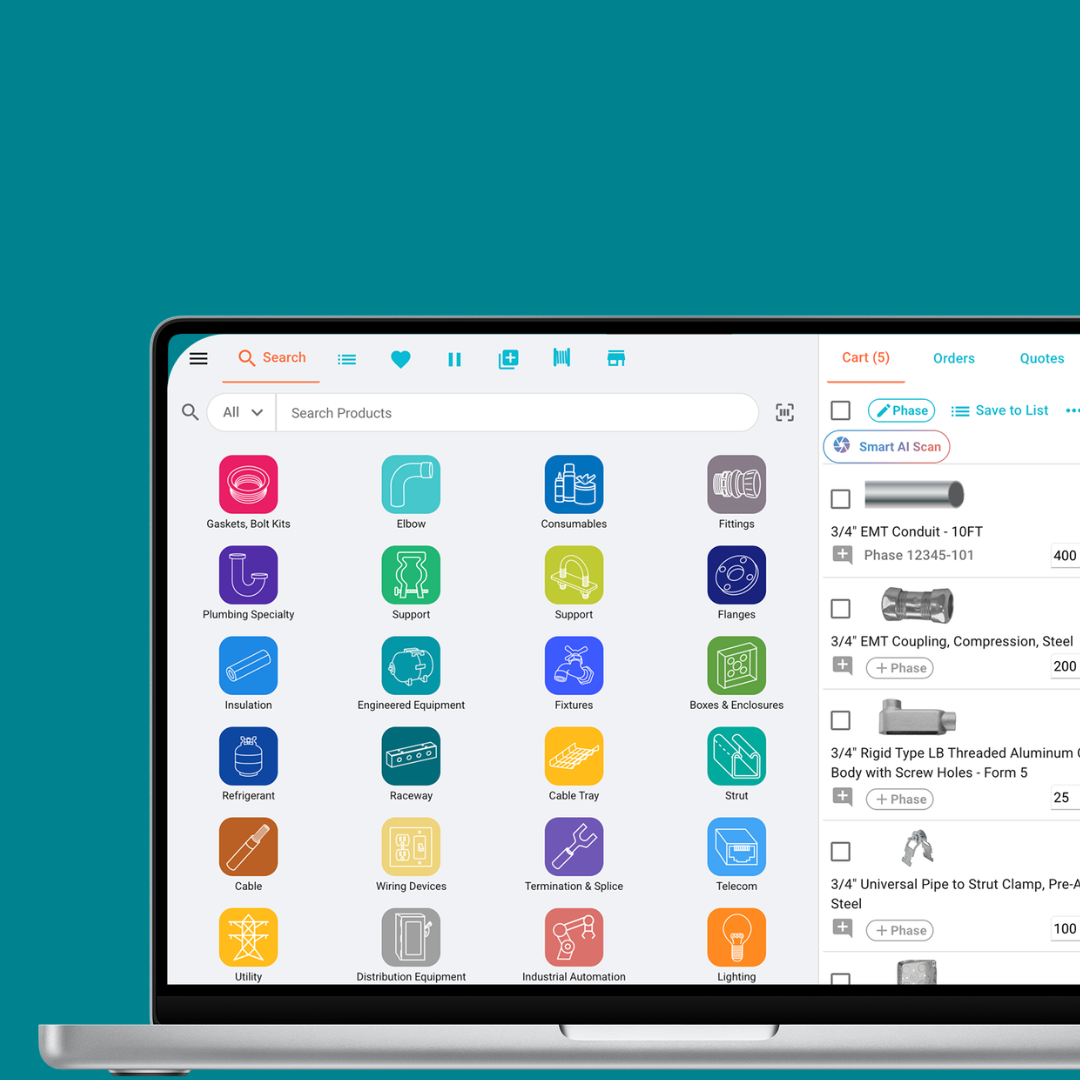
In a systems-based streamlined workflow, field teams can specify materials without being procurement experts. Visual catalogs show what products look like, not just part numbers. Search understands field terminology and returns correct results even when the foreman doesn't know the manufacturer SKU.
Christopher Seagrist at Morrow Meadows described this: "You can be pretty vague. You can put in slang terms that the field uses and it knows slang terms and it brings up items based off of what you're trying to look for."
Complete information flows automatically. Steven Druin at Interstates explained how this works: "If they're ordering 2 inch pipe it's gonna automatically offer them 2 inch connectors and 2 inch hangers and all these assorted accessories that go along with that 2 inch pipe. Getting their order entered quicker and more accurately so that they get the right material on site at the right time."
Job context syncs without manual data entry. A team member at Guarantee Electrical described the difference: "Our jobs sync out of Viewpoint into Remarcable, all of the shipping information, the job site addresses, the tax rates, all of that information comes right out of Vista into Remarcable. The foreman syncs in there. So a lot of the information is just seamlessly passing through."
The ultimate measure of seamless workflows is whether the company can grow revenue without proportionally growing overhead. Guarantee Electrical provided a dramatic example. A team member noted: "I was looking at reports earlier and yesterday we had 135 orders, 120 orders on the 14th. We would not be able to do that with just two purchasers alone, without Remarcable. That's not possible."
Moving from chaos to clarity
The material request workflow from field to supplier involves eight distinct steps and at least five major failure points. Every handoff is a potential failure point where information gets lost, time gets wasted, or errors get introduced. For most contractors, this workflow operates through phone calls, text messages, emails, spreadsheets, and tribal knowledge. Everyone operates with poor visibility into what's actually happening.
Remarcable was built by former foremen, purchasers, project managers, and engineers who had lived through these exact problems. The platform connects field teams, purchasing, suppliers, and accounting in one system with real-time visibility across the entire material lifecycle. A visual catalog of 500,000+ products with comprehensive slang mapping lets field workers find what they need without knowing manufacturer SKUs. Direct integration with 450+ suppliers means orders flow with complete, structured information. Integration with 15 accounting systems means job context, cost codes, and delivery addresses sync automatically.
For contractors tired of spending 40% of their team's time managing material chaos, Remarcable's field operations solution eliminates the translation errors, approval bottlenecks, and visibility gaps that turn simple material requests into multi-day ordeals. See how the platform works.
Connected purchasing and material operations for MEP contractors
See how contractors run procurement with Remarcable
Request a demo and we'll walk through exactly how it fits your team's workflow.
.png)