The Real Cost of Entering the Same Material Data Three Times
Triple data entry in construction wastes hours, creates errors, and costs contractors thousands. Here's the math.

The same material order gets entered three separate times before it hits the job site. Purchasing creates the purchase order. The warehouse receives materials against it. Accounting enters the invoice. Each entry takes time. Each entry creates an opportunity for error. Each error creates downstream problems that consume even more hours.
This isn't a minor inefficiency. For a mid-size electrical contractor processing 500 purchase orders per month, triple entry adds up to hundreds of hours of pure redundancy, or worse, hundreds of errors in data.. Hours that could be spent on value-added work instead of retyping or reconciling information that already exists somewhere else in the system.
Why manual entry waste compounds
Construction companies with $1 billion in revenue can lose up to $165 million per year due to poor data handling. Companies lose an average of $12.9 million per year due to poor data quality, with 24% of construction data containing wrong entries, 24% lacking information, and 21% incorrectly recorded.
The construction industry as a whole bears a staggering burden. Bad construction data cost the global industry $1.8 trillion in 2020 and was responsible for 14% of all avoidable rework, totaling $88 billion.
Manual data entry sits at the root of this problem. When the same information gets typed into multiple systems, the probability of errors multiplies. A transposed digit in the purchase order. A misread quantity on the receiving document. An incorrect cost code on the invoice entry.
Studies show that construction executives spend 1,300 hours per year organizing information across systems. That's 400% more time than peers using unified platforms.
Calculating the true cost
Start with direct labor costs. If a foreman requests a part, then a purchasing coordinator spends three minutes entering each purchase order, and accounting re-enters that same information at two minutes per invoice, that's five minutes of redundant work per transaction. For a contractor processing 500 POs per month, that's roughly 42 hours of pure duplicate effort every month.
At an average labor rate of $17 per hour for data entry work, that's $714 per month in direct costs just for the typing. Scale that across a year, and a mid-size contractor is paying over $8,500 annually just to type the same information twice.
The error costs dwarf the labor costs.
Each paper form in construction costs $10 to $50 when factoring in printing, distribution, scanning, and manual data entry. Industry data shows that companies spend 20 hours per week fixing payroll mistakes alone. The cost to process each invoice ranges from $15 to $40 depending on complexity.
For electrical contractors specifically, the stakes are higher. A company purchasing $200 million in materials annually, like Guarantee Electrical, processes thousands of transactions. Even a 1% error rate on that volume means $2 million in materials that require exception handling or correction.
The hidden opportunity cost
The most expensive cost isn't the clerical labor. It's the skilled workers who get pulled into data entry tasks because the systems don't talk to each other.
Jessica Nascusa, Senior Purchasing Agent at Morrow Meadows, described the communication breakdown: "The biggest challenge was the communication between the field, the vendors and getting the correct materials sometimes. You know it's kind of like playing telephone. There's a translation issue of they want a certain part, if you don't have those exact numbers, it's sometimes hard to remember everything to give to the vendor, and they're thinking of a different part."
Steven Druin, SVP of Technology at Interstates Electric, captured the problem clearly: "They wanted to order something like a four square box into our purchasing department and that opens the door for 30 more questions. How many, what size knockouts do you need, what kind of connectors do you need in the box, do you need brackets, what type of brackets. Creates so much more communication than is necessary and slows down the process."
This communication overhead burns out good people. One Collins Electrical field supervisor put it bluntly: "Before Remarcable, I spent half my morning chasing down order statuses."
The opportunity cost extends beyond individual productivity. When skilled workers are stuck in manual processes, the company can't scale. Growth hits a ceiling where adding more revenue requires proportionally adding more administrative headcount.
Data entry errors and downstream impact
The 1-10-100 rule from data quality research provides a useful framework. It costs $1 to prevent an error, $10 to fix it later, and $100 when it reaches the customer.
In construction terms, that translates to spending time upfront to get the order right, spending more time fixing it when the wrong materials arrive, or dealing with the full project impact when crews are sitting idle.
Manual entry at multiple points increases the probability for errors. A foreman might request 100 feet of 2-inch conduit. The purchasing coordinator, transcribing a handwritten requisition, enters 100 pieces. The accounting department, processing an invoice that shows "100 EA," matches it to a purchase order that should have said "100 FT." The error doesn't surface until the material arrives and the crew realizes they're short.
Paul Iorio, GM of Procurement Services at O'Connell Electric, highlighted the chaos of informal ordering: "The nice thing about Remarcable is the request comes from the field right to us, we know exactly what they want. It's not written on the back of a napkin or on a cardboard box. It's not taken on a screenshot from a telephone. It's not through an email, because they're picking out items we know exactly what to source."
What automated data flow looks like
Eliminating triple entry means connecting systems so data seamlessly flows back and forth.
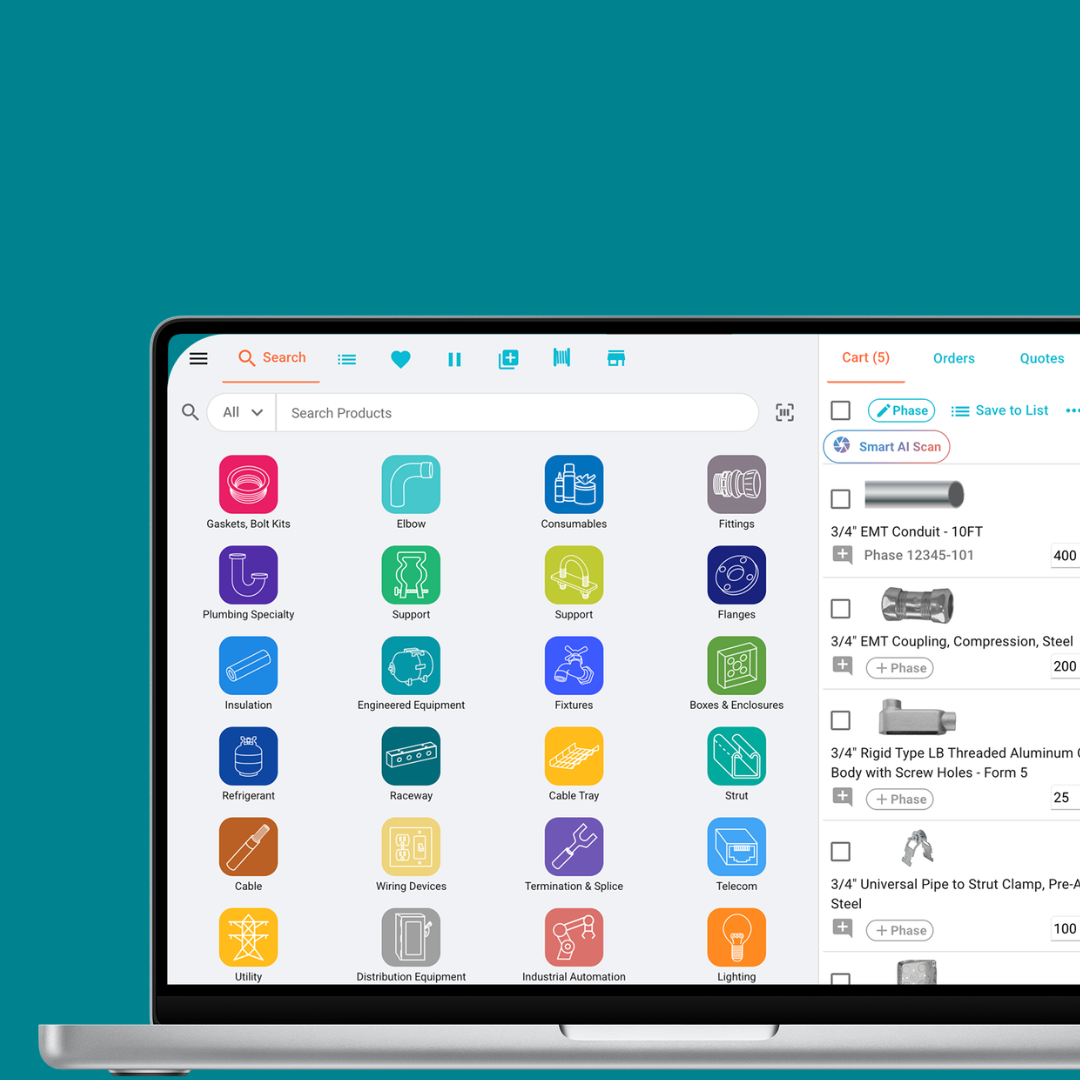
The foreman creates a requisition on a mobile device. That requisition becomes a purchase order without re-entry. The delivery creates a receipt record automatically. The invoice matches against the PO and receipt without accounting touching it, unless there's an exception.
Guarantee Electrical processes 120 to 135 purchase orders per day with just two purchasing coordinators. Without automation, that volume would require a significantly larger team.
The integration depth matters. Steven Druin emphasized this point: "A lot of companies say they integrate and that's what they want to say, especially when you're asking the question. When they truly don't, they're importing and exporting CSVs with minimal data flow at best. True integration is making API calls and pushing that data back and forth between automated systems."
Real integration means an order created in the procurement system immediately creates a corresponding record in the accounting system with the correct job codes, phase codes, and cost categories already mapped.
Collins Electrical reduced procurement cycle time from two to three hours down to 10 minutes per cycle. That improvement came from eliminating the handoffs, phone calls, and manual entry at each stage.
Real-time job cost data prevents overruns
The time lag between when costs are incurred and when they show up in job costing creates blind spots. If a project manager makes decisions based on last week's data because accounting is still catching up on entry, those decisions are already wrong.
Interstates Electric saved 14,000 to 15,000 hours over two years by eliminating manual processes in material ordering and invoice matching. The business impact came from faster, better decisions based on accurate data.
Michael Sadler, Pre Construction Manager at B&D Industries, described the transformation: "On our side to order the materials it's as easy as hitting a button and clicking submit and it's done. It takes a quarter of the time if that."
The three-way match between purchase order, receipt, and invoice becomes automatic when systems are connected. The software verifies quantities, prices, and items delivered. Exceptions get flagged for human review, but the 95% of transactions that match perfectly flow through without manual verification.
The path from triple entry to automated flow
Getting from manual, disconnected processes to automated data flow requires connecting systems through real integration. Procurement platforms that push purchase order data directly into accounting systems through APIs. Field applications that create requisition records that flow automatically into procurement queues. Invoice processing tools that read PDF invoices and match them against existing PO data without manual coding.
Remarcable was built specifically to solve this problem for electrical and mechanical contractors. The platform connects procurement, inventory, tool tracking, prefab operations, and field teams in one system, with direct integration to 15 accounting systems including Viewpoint Spectrum, Vista, Foundation, Sage, and QuickBooks. All integrations include AutoSync for job cost data, automated three-way matching between purchase orders, invoices, and deliveries, and phase code mapping so materials get charged to the right cost categories automatically.
The result is data entering once and flowing through the entire lifecycle. Over 40% of the top 50 electrical contractors in the United States have already made this shift. See how Remarcable's accounting integrations eliminate triple entry, or request a demo to walk through the specific integrations available for your ERP platform.
Connected purchasing and material operations for MEP contractors
See how contractors run procurement with Remarcable
Request a demo and we'll walk through exactly how it fits your team's workflow.
.png)