8 Features Every Construction PO System Needs
Eight PO system features that matter for contractors.

If you have been using a general purchasing tool or your ERP's built-in procurement module, you have probably noticed the places where it does not quite fit. The PO that needs a job number and phase code but the system only has department fields. The foreman who calls the office instead of using the app because it is too slow or doesn’t work on the job site. The invoice that sat in a pile for two weeks because nobody could match it to the right delivery.
Those gaps add up. Construction purchasing has requirements that general procurement tools were not designed around, and the difference between a system that handles them and one that works around them shows up in how much time the team spends on workarounds every week.
These are the eight features that matter most when the work involves multiple active jobs, field crews ordering materials, and an accounting system that needs every dollar in the right cost code.
Job costing at the line-item level
Every line item on a purchase order needs to carry a job number, phase code, and cost code from the moment it is created. When those codes are there from the start, material costs flow into job cost reports without anyone re-entering them or having to find them later.
At a contractor running 15 to 30 active jobs, there are hundreds of open POs at any given time. If those POs do not carry job cost data natively, someone in accounting ends up coding invoices after the fact, working from memory or chasing project managers for context. That is where errors start creeping in. Guarantee Electrical, which processes $200 million in annual material purchases through Remarcable, described how it works when the data flows correctly: "Our jobs sync out of Viewpoint into Remarcable. All of the shipping information, the job site addresses, the tax rates. All of that information comes right out of Vista."
Approval routing by job and dollar amount
A $500 conduit order for a routine job does not need the same approval chain as a $50,000 switchgear purchase. The system needs to route approvals based on dollar thresholds, job type, and who is requesting, and it needs to do it fast enough that nobody feels like they are waiting.
When the approval process is slow or requires leaving the system, crews find a way around it. They call the supplier directly, and the PO gets created after the fact, if at all. That is how maverick spend builds up to 20 to 35% of total purchasing at many firms, with orders placed outside of negotiated pricing and without proper cost coding. The fix is making the system faster than the workaround, not adding more layers of approval.
Visual catalog with trade terminology
Most general procurement tools do not have this functionality, and it is often what determines whether field teams use the system or go back to calling the office directly.
A foreman who needs a 3/4-inch compression coupling thinks in terms of what the part looks like and what the crew calls it on site, not the manufacturer’s SKU. A construction PO system with a visual catalog lets crews browse by image and search using the slang terms the trade actually uses. Fred Robinson at Copper State, one of the largest electrical distributors in the Southwest, described how it works in practice: "It takes someone in the field from a phone, a tablet, or even a desktop device. They can work from a pictorial catalog. Any product within the electrical industry is there."
Without that visual layer and slang mapping, there is a translation step between what the field requests and what purchasing orders. That is where wrong parts ship, returns pile up, and jobs lose days waiting for correct materials.
Mobile field ordering
Material needs come up on the job site, not at a desk. The PO system needs to let field crews submit material requests directly from a phone or tablet, with the job number, cost code, and delivery location already attached.
The real test is simple: if it is slower than making a phone call, nobody will use it. It needs to work on job-sites with spotty cell coverage, load fast, and not require a training session. Paynecrest Electric put it plainly: "If you can use Amazon, you can use Remarcable."
For contractors building out service divisions, this matters even more. Service electricians working from vans at customer sites need to order parts on the spot without routing everything through the main office.
Supplier integration depth
There is a big difference between a system that emails a PO as a PDF and one that transmits the order electronically with line-item detail, gets an automatic confirmation from the supplier, and pulls back real-time pricing and availability.
The first version just moves the paperwork to a screen. The second actually removes steps. That gap is what creates the black hole between order and delivery where nobody knows whether the order was received, when it is shipping, or whether the price changed. With material prices shifting regularly and tariffs pushing effective rates to a 40-year high on construction goods, pricing accuracy at the point of ordering makes a difference.
Lighthouse Electric described the consolidation benefit: "A lot of distributors want you to use their portal and place your orders through their portal, and then you go to another distributor, a different portal. You're now trying to learn two, three systems."
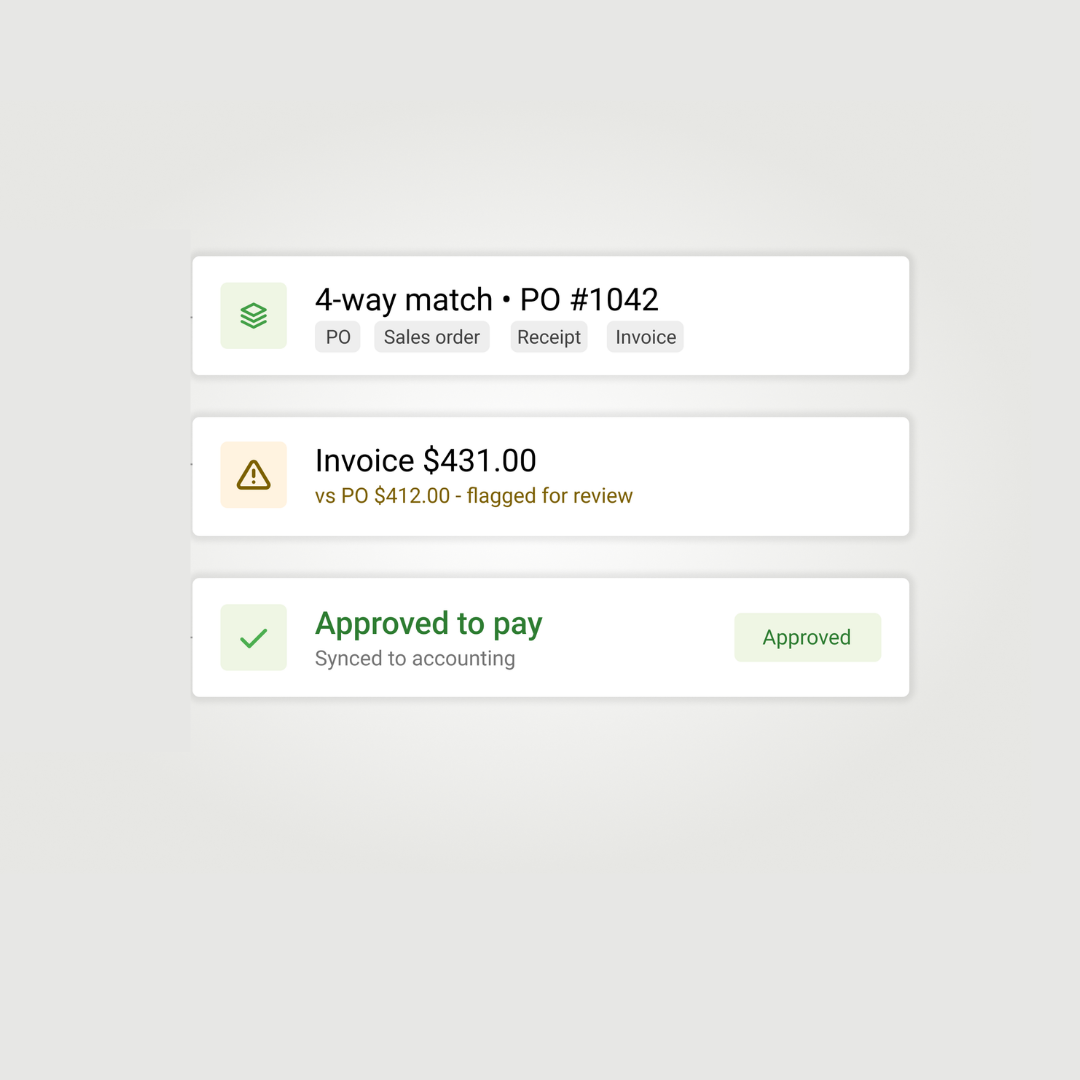
Three-way matching
Three-way matching checks what was ordered (the PO), what was received (the delivery), and what was invoiced (the supplier's bill) and that they all align. When they do not and the discrepancy slips through, the contractor pays for materials that never arrived, pays the wrong price, or charges the wrong job.
At industry net margins of 5 to 6%, those errors go straight to the bottom line. Guarantee Electrical described what the manual version of this looked like: "We would spot check invoices to make sure that pricing was appropriate. With the amount of material we buy, we can only spot check a very small percentage of that. So it wasn't a good reflection, it wasn't a good check and balance."
When matching is automated, exceptions get flagged before payment rather than surfacing during end-of-job reconciliation when it is too late to recover the difference.
Smart part recommendations
When someone orders 2-inch conduit, they also need 2-inch connectors, hangers, and associated accessories. In a manual process, the incomplete order gets discovered on the job site when the crew realizes that only the conduit was ordered but the fittings were not. This now requires a follow-up order, and results in delivery delays, idle labor, rescheduling.
A construction-specific PO system can suggest related components based on what is being ordered. Steven Druin, SVP of Technology at Interstates, described how this works with Remarcable: "If they're ordering 2-inch pipe, it's gonna automatically offer them 2-inch connectors and 2-inch hangers and all these assorted accessories that go along with that 2-inch pipe. Getting their order entered quicker and more accurately so that they get the right material on site at the right time."
In order to accomplish this, it requires a system catalog that understands how construction materials relate to each other which is why it is not something general procurement tools or ERP modules typically offer.
Accounting system integration
The last piece of the puzzle is getting PO data into the accounting system with full job cost detail accurately and intact. There is a real difference between integration and data export, and it matters more than most teams realize until they are living with it.
Data export means someone downloads a CSV and imports it into the accounting platform. Fields get mapped incorrectly, line items truncate, and the accounting team spends time reconciling differences. When Interstates evaluated systems, they found the problem firsthand: "7 different disparate systems where the job site name and address was entered differently in each system. Somebody might have shortened the name in System 2 compared to System 1."
True integration means PO data flows into accounting automatically with job number, phase code, cost code, unit price, quantity, supplier, and tax all intact. Everything else depends on this working. Job costing at the PO level is only valuable if data actually reaches the books clean.
These eight features are what separate a PO system built for construction from a general purchasing tool adapted for it. If you are evaluating options, Remarcable is one example of a platform built around these workflows for electrical and mechanical contractors, and seeing any system against your own purchasing process is the fastest way to know whether it fits.
Connected purchasing and material operations for MEP contractors
See how contractors run procurement with Remarcable
Request a demo and we'll walk through exactly how it fits your team's workflow.