5 signs you need construction inventory software
Five warning signs that your construction inventory process has outgrown spreadsheets, what is it costing your business
.png)
Materials represent 30 to 40% of total project costs. The systems tracking those materials at most contracting operations are the same ones that worked at half the current volume: spreadsheets, phone calls, and people who carry the information in their heads.
The gap between what those systems can handle and what the business demands doesn't widen gradually. It suddenly hits a threshold where small inefficiencies compound into real costs. Field crews ordering materials that already sit in a warehouse. Project delays from shortages that nobody saw coming. Reconciliation consuming days of administrative time that could go towards billable work.
The five signs below represent that threshold. The purchasing coordinators, warehouse staff, and project managers doing this work are making the best decisions they can with the information available to them. The problem is how little information they actually have.
You keep buying materials you already own
This is the most expensive symptom and the easiest to miss. A foreman orders conduit for a job, not knowing that two floors of the same building already have a surplus from a scope change. A project manager requisitions fittings from a supplier while the same fittings sit in a warehouse 20 minutes away. Nobody is making a mistake. They're making rational decisions based on incomplete information.
The root cause is visibility. It's faster to order new materials than to chase down whether existing stock is available somewhere else across the company's locations. When the only record of what's where lives in a spreadsheet that someone updated last Tuesday, defensive ordering is the logical move.
Up to 30% of materials delivered to construction sites end up as waste, and duplicate purchasing is a significant contributor. The industry assumes 2.5 to 5% material waste rates, but actual rates run closer to 10 to 15%. That gap represents materials that were ordered, paid for, and never used, or ordered twice because there was no systematic way to check against existing stock.
The consequences extend beyond the purchase price. Duplicate materials consume warehouse space, tie up working capital, and create aging inventory that risks obsolescence, damage, or waste. For electrical contractors, where copper wire and cable prices are up 22.3% year over year and steel mill products have climbed 20.9%, the financial impact of carrying unneeded inventory compounds quickly.
This is the sign that connects most directly to why contractors keep buying materials they already have. The pattern persists because the process allows it, not because people aren't paying attention.
Material shortages surprise you mid-project
The inverse of duplicate ordering is equally damaging: not knowing what you need until you don't have it.
When a crew reaches a phase of work and discovers that the materials they need haven't been ordered, or were ordered but haven't arrived, or arrived but went to a different site, the project stalls. Crews get resequenced. Schedules slip. Premium pricing kicks in for expedited orders because standard lead times are no longer an option.
98% of construction projects face delays, and roughly 40% experience supply chain disruptions as contributing factors. Material shortages don't always originate in the supply chain. Many start with internal visibility gaps: the materials were available somewhere across the company's locations, or the need was predictable but nobody had the data to predict it and order it in a timely fashion.
The pattern shows up most during schedule compression. Project delivery timelines are compressing 10 to 20% across the industry, meaning there's less buffer to absorb a shortage. When timelines were more generous, a crew could work around a missing material delivery for a day or two without cascading consequences. With compressed schedules, a single day of lost productivity can push a completion date by a week once resequencing effects ripple through the plan.
The labor context makes this worse. With 92% of construction firms reporting difficulty finding workers, idle crew time has a higher cost than ever. A four-person crew waiting half a day for materials that should have been on site represents billable hours the business doesn't recover, on top of the schedule impact.
Nobody knows what's in the warehouse without going there
What do you have in stock right now? At most contracting operations, answering that question requires someone to physically go and look.
Warehouse managers and purchasing coordinators develop a working knowledge of what's on the shelves, but that knowledge is approximate, incomplete, and unavailable to anyone who isn't standing in the building. When a project manager calls to ask if there's enough 3/4-inch EMT conduit to cover a job, the answer depends on who picks up the phone and whether they checked the racks recently.
Purchasing can't confidently use existing stock to fill requisitions because they can't verify quantities remotely. Project managers can't factor warehouse inventory into their material plans because the data isn't accessible. Foremen can't check whether what they need is already at a nearby site because the information doesn't exist in any queryable form. The downstream impacts are predictable: defensive ordering that ties up working capital, and emergency purchases at premium pricing that erode margins.
Only 26% of contractors rate their current data quality as high. Inventory data, in particular, degrades quickly. Items get pulled from shelves without updating records. Deliveries arrive and sit for days before they're logged. Transfers between locations happen informally (a photo of a packing slip, a text message, a note on a timecard) without systematic tracking.
The consequences multiply across locations. A contractor running 15 active job sites, two warehouses, and a fleet of service trucks has inventory distributed across nearly 20 locations. Without a real-time system connecting each of those locations, each one is effectively its own island. The company has enough total inventory to avoid new purchases, but nobody can see the full picture.
Physical inventory counts consume entire days
A full physical inventory at a busy warehouse can take a team of two or three people an entire day. Across multiple locations, the time investment stretches into multiple days of work that pulls people away from their primary responsibilities.
Annual or quarterly counts are necessary for financial reporting and job costing accuracy. The counts are necessary. The cost of doing them manually is the problem. Staff who could be processing orders, coordinating deliveries, or managing job site logistics are instead walking aisles with clipboards, counting items that a real-time system would track easily and continuously. 35% of working time in construction goes to non-productive activities, and physical inventory counts are a concentrated example.
The time cost is only part of the issue. The accuracy problem is just as significant. By the time a manual count is complete and reconciled, the numbers are already stale. Materials shipped during the count, deliveries that arrived mid-process, and transfers that happened between the start and end of the count all introduce discrepancies. 88% of spreadsheets contain errors, and manual inventory counts rely on the same human data entry processes that produce those error rates.
Contractors with service divisions (maintenance contracts, NFPA compliance work) feel this acutely. Van stock for service electricians needs to be tracked across dozens of vehicles, each one a miniature warehouse with its own inventory that changes daily. Counting van stock manually means pulling service technicians off revenue-generating work to verify what's in their truck, or accepting that the company has no real visibility into a significant pool of materials.
Reconciliation at month-end is a multi-day ordeal
When procurement data, inventory records, and accounting systems don't share a common source of truth, someone has to manually connect them. That someone (or more often, that team of two or three people) spends the last few days of every month chasing discrepancies.
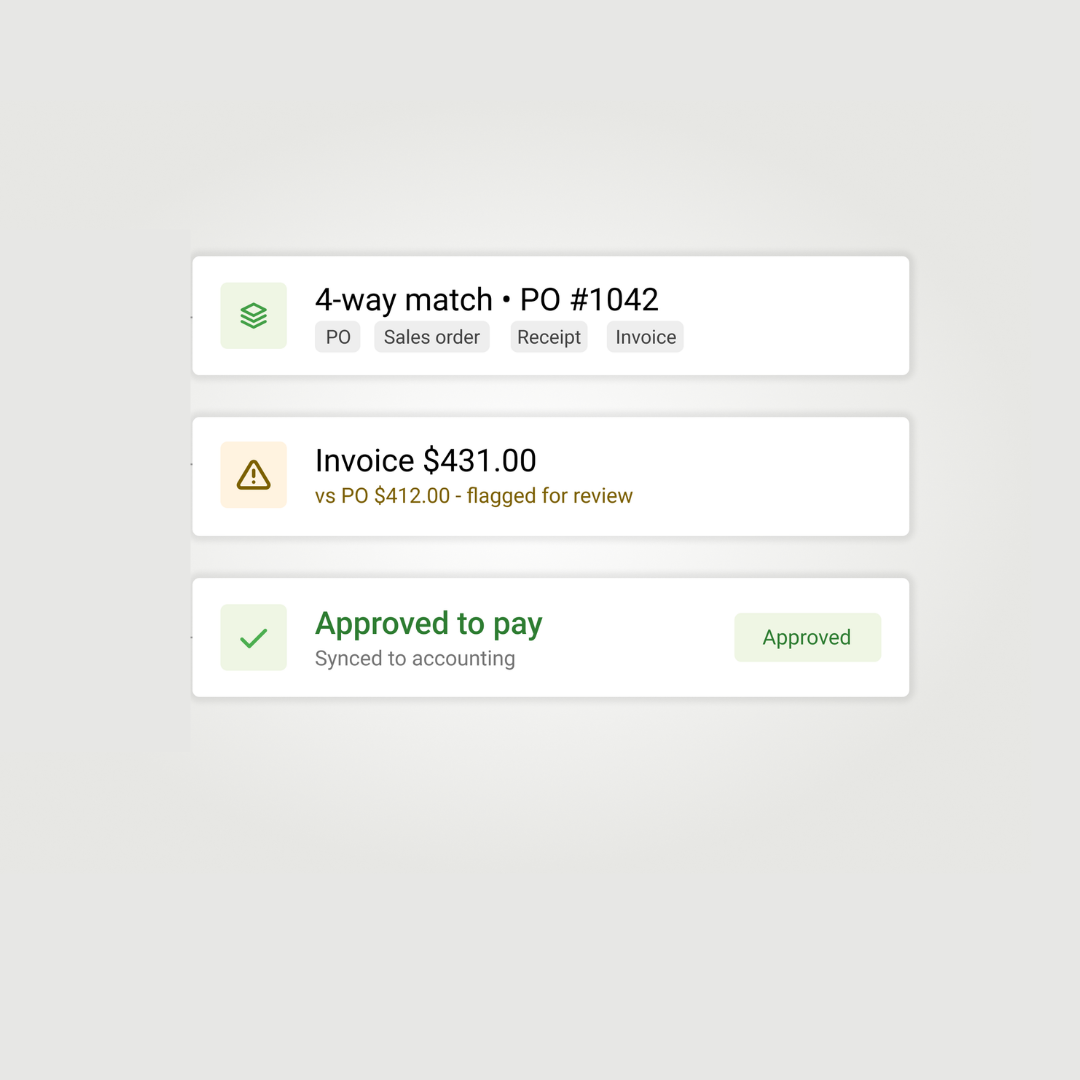
The reconciliation problem starts small. A purchase order for 50 units gets partially delivered, with 35 arriving on one day and 15 the next week. The supplier invoices for the full 50. Receiving logged 35 but the second delivery never got entered. Accounting has an invoice that doesn't match the receiving record, which doesn't match the PO, which doesn't match what's physically on the shelf. Each discrepancy requires someone to trace the chain of events through emails, delivery receipts, PO revisions, and supplier communications.
At scale, this becomes consuming. Guarantee Electric described processing 135 purchase orders in a single day with just two purchasers and managing $200 million in annual material spend. At that volume, even a small percentage of orders requiring reconciliation creates a substantial administrative burden.
The financial risk is real. Only 31% of construction projects come within 10% of their original budget, and reconciliation gaps contribute directly to budget overruns. When invoice amounts don't match purchase order totals and nobody catches the discrepancy, the overpayment gets absorbed into project costs. With net profit margins in construction running 5 to 6% on average, and often closer to 1.4 to 2.4% for many firms, a few undetected pricing discrepancies per month can represent a meaningful percentage of profit.
The time dimension matters, too and has downstream impacts. Month-end reconciliation that takes three or four days delays financial reporting, which delays job costing updates, which delays the ability to assess project profitability while there's still time to correct course. The information arrives too late to act on it.
What these signs have in common
Each of these signs points to the same underlying condition. The people making purchasing and inventory decisions don't have timely and accurate information they need to make good ones.
The foreman ordering duplicate materials doesn't have visibility into what's already in the warehouse. The project manager that is surprised by a shortage doesn't have a system connecting material requirements to current inventory and incoming deliveries. The purchasing team spending days on reconciliation is reconstructing information that should have been captured automatically at every step of the transaction.
These signs compound when everything else is getting tighter. Fewer people to absorb administrative overhead when 92% of firms report difficulty finding workers. Less margin for error when schedules compress 10-20%. Higher dollar cost for waste and duplication when tariff rates on construction goods hit a 40-year high of 25 to 30%.
Every sign gets worse as the business grows. A contractor running five jobs can manage inventory through relationships and memory. At 15 or 20 active projects, with multiple warehouses and a service division, the same approach produces the symptoms above. The business has outgrown the process.
Construction inventory management software addresses the information gap directly: real-time visibility across locations, automated tracking as materials move through the system, and data that connects procurement, receiving, and accounting without manual reconciliation. Platforms like Remarcable are built for the specific complexity of trade contractors, where inventory spans job sites, warehouses, prefab shops, and service vehicles.
The question is whether your current process can support the volume and complexity you're building toward, or whether the cracks are already there and the cost has been hiding in margins.
Connected purchasing and material operations for MEP contractors
See how contractors run procurement with Remarcable
Request a demo and we'll walk through exactly how it fits your team's workflow.