AI can't fix a disconnected business: Connection comes first
Contractors are buying AI procurement tools before their data is ready to support them. The 11-point performance gap is the proof.

Key Takeaways
- 82% of contractors expect AI to give them a competitive edge; only 26% rate their data quality as high. The conviction and the foundation are out of sync.
- AI doesn't create structure. It amplifies whatever data environment it finds, whether clean or fragmented.
- ERP adoption and connected data aren't the same thing. CSV exports and batch imports are not real-time integration.
The AI investment conversation in construction has a sequencing problem. Contractors are ready to buy tools; the data infrastructure those tools depend on isn't ready to receive them.
That's an architectural argument. And the numbers bear it out. According to CMiC-sponsored research via Dodge Construction Network, 72% of contractors believe AI will give them a competitive advantage. In the same survey, only 26% rate their current data quality as high. Those two facts, sitting side by side, are the whole problem. The conviction is there. The foundation isn't.
Before you evaluate any AI tool for procurement, one question matters more than the feature set: what data will it run on?
If the answer is "email threads, spreadsheets, and phone calls between the foreman and the purchasing desk," the tool's ceiling is already set, and it's low. AI doesn't create structure where none exists. It amplifies whatever structure it finds. Give it clean, connected data and it performs. Give it fragmented inputs and it gives you fragmented outputs dressed up in a better interface.
The Autodesk/FMI study put a number on what bad construction data costs globally: $1.85 trillion annually. That figure encompasses the full lifecycle: design errors, rework, poor decision-making, delays. But procurement carries a disproportionate share of it, because procurement is where the data problem is most acute and where AI adoption is lagging hardest.
Why procurement is where the data gap bites hardest
A foreman's field order that goes unrecorded is a missing AI input. Email-based purchasing creates the same gap: a transaction happens, but no structured record is captured. When purchasing runs through text messages, calls, and PDFs, the data trail is either absent or locked in formats an AI can't act on.
The Dodge research found that only 9–19% of contractors who are aware of procurement and vendor management AI are actually using it, well below adoption rates for other construction AI categories.* That gap isn't skepticism about AI. It's a recognition, conscious or not, that procurement data isn't set up for it.
A separate peer-reviewed study from Taylor & Francis (2025) on construction SME procurement identified manual workflows and poor communication as the core constraint, ahead of missing tools. The tools are available. The data architecture to support them isn't.
The ERP doesn't solve it
Most contractors with an ERP assume they're already connected. ERP adoption and data quality are not the same thing. The 26% high-quality data finding comes from contractors who, in most cases, have ERPs. The systems exist; the data flowing through them doesn't.
Steven Druin, SVP of Technology at Interstates Electric, described the failure mode precisely in a conversation about integration: "A lot of companies say they integrate and you know that's what they want to say off the back... When they truly don't, they're importing and exporting CSVs with minimal data flow at best. True integration is making API calls and pushing that data back and forth between the automated systems."
That's integration theater: the appearance of connection without the substance. An ERP that receives a nightly CSV from your purchasing system isn't connected procurement data. It's a snapshot, already hours old, already missing the context it would need to be useful.
The gap between high-quality and moderate-quality data
According to CMiC-sponsored research via Dodge Construction Network, contractors with high-quality data rate AI effectiveness at 81%. Those with moderate-quality data (present but gappy and inconsistent) rate it at 70%. An 11-point gap, driven entirely by data quality.*
Independent research reinforces the pattern. A Procore/Dodge study on construction tech adoption found that 82% of optimized tech users report performance benefits vs. 31% of light adopters. The specific mechanism differs, but the finding is the same: depth of connection determines outcomes. The tool is not the variable.
This is what sets the ROI ceiling on any AI investment in procurement. The tool you're evaluating is not what limits performance. Your data environment is.
What connected procurement data looks like
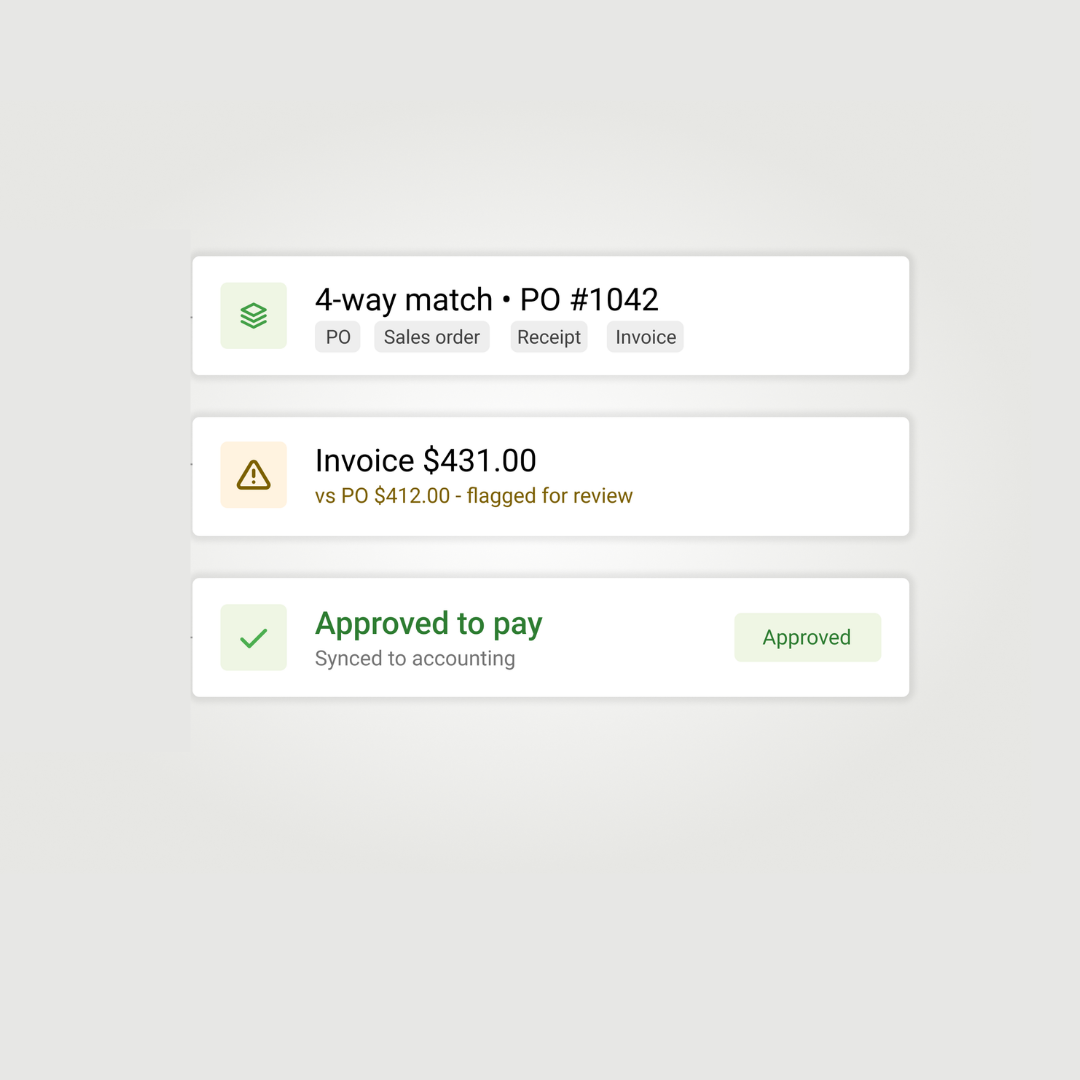
Connected procurement data means every transaction (field request, PO, receipt, invoice) moves through a single structured system without manual re-entry or CSV hand-off. When a foreman submits a request from the job site, it carries the job number, phase code, and contact information automatically. When the invoice arrives, it matches against the PO and the receipt automatically. When there's a discrepancy, someone is alerted before payment takes place.
That structure is what AI needs to function. Smart recommendations can't learn your purchasing patterns from email threads. Invoice matching can't catch discrepancies from spot-checked PDFs. Inventory recommendations can't prevent redundant orders from data that isn't current.
The connected procurement layer IS the prerequisite. That infrastructure has to be in place before an AI deployment has anything real to work with.
What AI does when the data is there
When procurement runs through a connected system, AI stops being theoretical. Invoices get checked against purchase orders automatically. If a supplier commits to a price and the invoice comes in different, the discrepancy surfaces before payment, not during a quarterly audit after the fact. Guarantee Electrical described their old process: "We would spot check invoices to make sure that pricing was appropriate. With the amount of material we buy, we can only spot check a very small percentage of that. So it wasn't a good reflection, it wasn't a good check and balance." That changed with connected data: "Now we don't have to do that. That is all done automatically through Remarcable. And if someone committed to a price to us, they're held at that price, and if we don't receive that price, we're alerted to it."
Smart recommendations work the same way. When all purchasing history is captured in one system, the platform learns what accessories accompany an order, what suppliers have the best lead times for specific products, and what's already in inventory that might cover the request. None of that works from a spreadsheet and a box of email threads.
This is what Remarcable Intelligence does when the data is there: invoices get checked against POs automatically, discrepancies surface before payment, smart recommendations learn from actual purchasing history so orders arrive complete, and inventory awareness stops redundant purchases before they happen. Procurement teams get accurate information to act on, automatically, at scale, without replacing their judgment. Guarantee Electrical runs 120 purchase orders a day with two purchasers. That's not possible without the data layer underneath.
That recognition earned external validation: Remarcable received AI-driven procurement innovation honors at the EC&M Product of the Year 2025 awards, specifically for what AI does when it runs on connected procurement data.
The sequencing argument
The case for AI in procurement is real. Competitive pressure to compress project timelines by 10–20% means the administrative overhead of manual purchasing isn't sustainable. Procurement needs to run faster, with fewer errors, at higher volume, and AI can do that.
But the sequence matters. Layering AI on disconnected procurement data produces a marginally smarter version of the same fragmented system. The 11-point effectiveness gap between high- and moderate-quality data has nothing to do with the tools. It's entirely about what the tools have to work with.*
The question to ask before any AI procurement tool evaluation isn't "what does this tool do?" It's "what does our data environment look like when this tool tries to use it?"
If the answer is 7 systems with different job site names and addresses, field orders arriving by text, and invoices reconciled by spot check, fix that first. The AI will perform better for it.
If your procurement data looks like this, book a demo — we'll show you what connected data infrastructure looks like before you layer AI on top of it.
Source: CMiC-sponsored research via Dodge Construction Network, "AI for Contractors" (2025).
Connected purchasing and material operations for MEP contractors
See how contractors run procurement with Remarcable
Request a demo and we'll walk through exactly how it fits your team's workflow.
.png)