The Black Hole Between Order and Delivery: Why Material Visibility Dies in Construction
Material orders disappear into a black hole between ordering and delivery.

Everyone knows the feeling. You placed the order days ago. The warehouse said it would ship yesterday. The foreman needs it tomorrow morning, and the crew is already scheduled. Everything downstream depends on materials that should be in transit right now, but nobody can actually tell you where they are and if they are going to show up on time for the job.
Did the supplier get the purchase order? Did they acknowledge it? Is it in stock or sitting in backorder? Has it shipped yet? Where's the truck? Will it show up before the crew does?
These questions matter because 60 to 70 percent of project delays trace back to materials: late deliveries, wrong items, supply chain hiccups. The anxiety isn't irrational. When visibility dies somewhere between "I ordered it" and "it showed up," schedules slip and money disappears with them.
The information gap
The black hole isn't one failure. It's a cascade of unknowns that starts the moment a purchase is sent.
Take something as basic as order confirmation. A foreman submits a requisition, the PM approves it, purchasing sends it to the supplier. But did the supplier's system actually receive it? Or did it land in someone's inbox and sit unacknowledged for three days while your team assumed everything was on track? In situations like these, visibility matters.
Stock availability is another blind spot. The supplier's website might show the item as available, but that data could be days old. Partial stock means partial shipments, and partial shipments mean crews standing around waiting for the pieces that didn't make the truck. Material availability issues are a primary driver of schedule risk, pushing average project durations roughly 37 percent longer than planned.
Even when something ships, visibility often goes dark again. Some suppliers provide tracking numbers, some don't. When you do have tracking, it tells you where the truck is but not whether your specific order is on this load or the next one–and is it complete or partial? For contractors managing multiple job sites, a delivery that shows up at the wrong gate or wrong building creates its own cascade of problems.
Where the money goes
A field supervisor at Collins Electrical put it simply: "Before Remarcable, I spent half my morning chasing down order statuses."
Half a morning. One person. Now multiply that across every project manager in a growing contracting company. Hours of capacity every day disappear into coordination overhead instead of actual project work.
The crew impact cuts deeper. When electricians show up ready to rough in electrical rooms and the MC cable isn't there, you're choosing between bad options. Send them home and eat the lost day. Reassign them to work they weren't prepped for. Pay them to wait while someone scrambles. None of these get back the productivity and money you’ve lost.
Guarantee Electrical quantified part of this when they found 40 percent of their workforce's time tied up in material management rather than actual electrical work. With $200 million in annual material purchases, inefficiency at that scale shows up directly in margins.
And when materials arrive late, the schedule doesn't magically expand to accommodate them. Two days late means overtime, weekend work, or accepting that the project will slip. It costs exponentially more when you discover on the job site that a backorder didn’t arrive versus having visibility at the front end when the PO was first submitted and you would have had time to find alternatives.
Why systems don't talk
This isn't a people problem. Purchasing departments aren't dropping the ball. The problem is that the systems involved were never designed to share information automatically.
Purchasing runs on ERP systems like Viewpoint or Sage. These are fundamentally office tools, built for people at desks. They're not designed for foremen on job sites with spotty cell coverage trying to check order statuses from a phone.
Suppliers have their own order management systems. When your PO comes in, it gets entered into their world, which may or may not have any real connection back to your ERP. Steven Druin, SVP of Technology at Interstates Electric, has seen this up close: "A lot of companies say they integrate... when they truly don't, they're importing and exporting CSVs with minimal data flow at best. True integration is making API calls and pushing that data back and forth between automated systems."
So email becomes the connective tissue. A supplier sends a shipping confirmation, purchasing reads it and forwards it to the PM, and the PM texts the foreman. By the time the information reaches the person who actually needs it, it's been reformatted twice and probably lost details along the way.
Field teams add another layer of disconnection. Foremen and crew leads don't have ERP access. They submit material requests through paper forms, PDFs, or text messages. Jessica Nascusa, Senior Purchasing Agent at Morrow Meadows, knows this dynamic well: "The biggest challenge was the communication between the field, the vendors and getting the correct materials sometimes. You know it's kind of like playing telephone. There's a translation issue."
When a project manager calls purchasing to ask where an order is, someone has to dig through the ERP, check email for supplier confirmations, possibly call the supplier if they can’t find current information, and then relay the answer back. Fifteen minutes per inquiry, easily. Scale that across dozens of active jobs and hundreds of open purchase orders, and purchasing becomes a customer service desk instead of a strategic function.
What changes when visibility works
Real visibility doesn't mean a dashboard or a tracking number. It means the people who need to know can see what's happening without asking anyone, without making calls, without waiting for someone to look something up.
Christopher Seagrist, Prefab Coordinator at Morrow Meadows, described the shift: "Now Remarcable takes care of all that for me. I can go and I can order everything in a one stop shop, kind of like online ordering."
When project managers can pull up an order and see that it shipped yesterday and will arrive at 10am tomorrow, they don't need to call purchasing. The "where is my stuff?" calls just stop happening and chaos turns to order. Purchasing gets to focus on supplier relationships and cost management instead of fielding status inquiries all day.
Michael Sadler, Pre Construction Manager at B&D Industries, explained what planning looks like when you can actually trust the data: "We can actually follow it from our request or the foreman's request all the way through to delivery and we know an exact day when that material is coming and we can plan out that way. We can forecast when the build is actually gonna be done."
The biggest value might be catching problems before they become emergencies. A team at Paynecrest Electric described it: "If you order something from the warehouse, they will send you a message right away saying, we've got your order, or, 'Hey, we don't have this right now. Should we purchase it right now? Or can you wait a couple days?' And that message comes back instantaneously."
Paul Iorio, GM of Procurement Services at O'Connell Electric, captured what clean information flow feels like: "The nice thing about Remarcable is the request comes from the field right to us, we know exactly what they want. It's not written on the back of a napkin or on a cardboard box. It's not taken on a screenshot from a telephone. It's not through an email."
Closing the gap
The black hole isn't really a technology problem. It's a connection problem. The information exists—suppliers know what's in stock, carriers know where trucks are, contractors know what jobs need which materials. The data is there. Systems just don't share it automatically with everyone who needs it.
Most contractors live with the gap because it feels unavoidable. Materials management has always meant phone calls, email chains, and manual coordination. But when competitors are handling 135 purchase orders a day with two purchasing staff, when field supervisors aren't spending half their mornings chasing order statuses, the chaos stops being unavoidable.
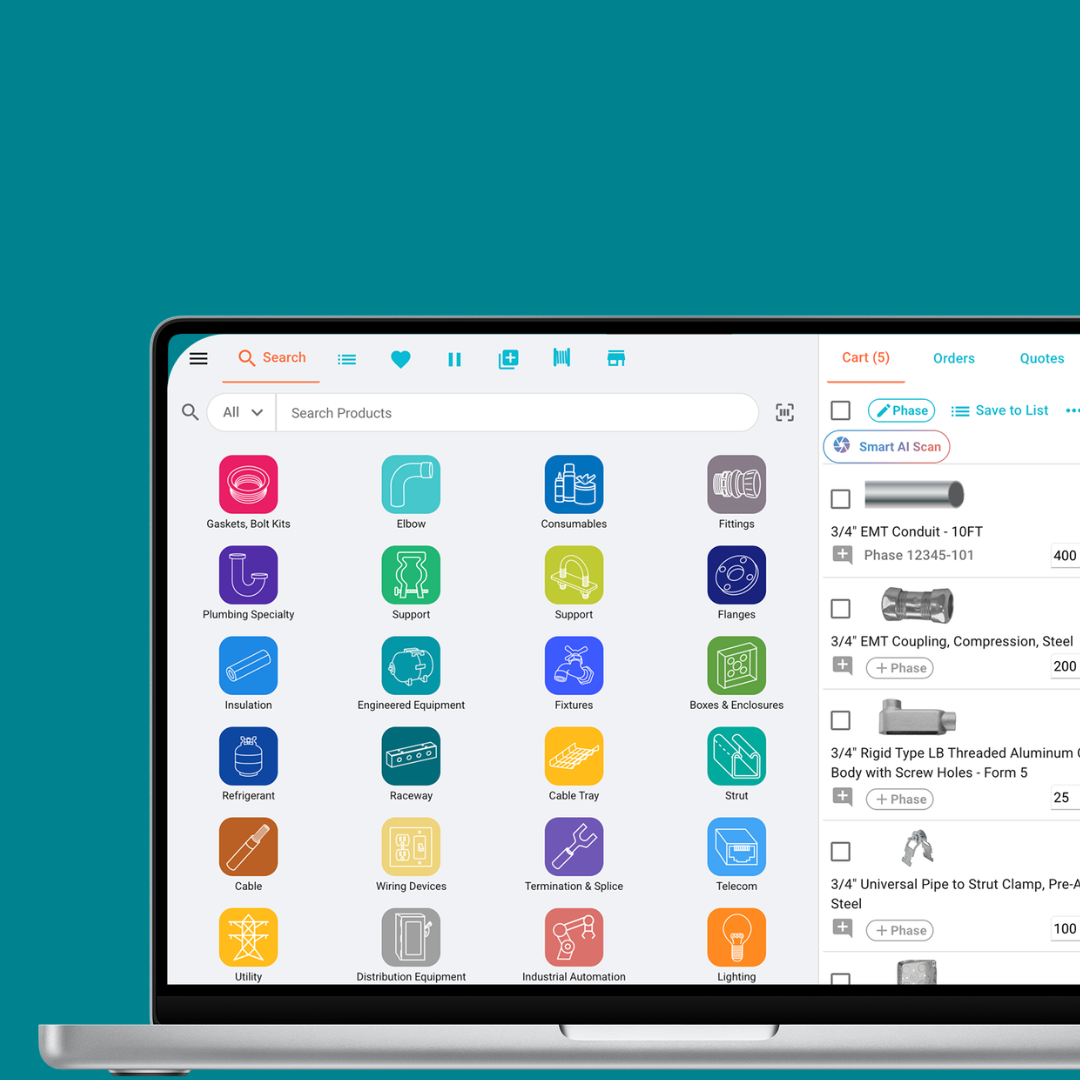
Remarcable was built to close the gap for electrical and mechanical contractors. The platform connects field requisitions, purchasing workflows, supplier systems, and accounting in one place where visibility doesn't break. Integration with 450+ suppliers means order acknowledgments, stock updates, and shipping confirmations flow through automatically. The visual catalog of 500,000+ products eliminates the translation errors that happen when field teams describe what they need and purchasing has to decode part numbers.
Materials still take time to ship and deliver. But the anxiety of not knowing where they are or when they'll arrive doesn't have to be part of the job. See how visibility works when the systems actually connect.
Connected purchasing and material operations for MEP contractors
See how contractors run procurement with Remarcable
Request a demo and we'll walk through exactly how it fits your team's workflow.
.png)