What Is Construction Inventory Management Software
Construction inventory software connects material data so contractors stop buying what they already own.
Have you experienced this situation? A project manager calls the warehouse to check wire stock before placing an order. The warehouse manager pulls up a spreadsheet, says there should be six spools on the shelf. The PM orders more anyway, because "should be" and "is" are different things when materials are spread across a dozen locations. Two weeks later, the extra spools that were ordered are sitting at a job site that doesn't need them, while another project scrambles to source the same wire at rush pricing, again.
Materials represent 30-40% of total project costs, and the industry assumes 2.5-5% will be wasted when actual waste rates run 10-15%. The gap between what a contractor thinks they have and what they actually have at any given location is one of the most expensive problems in the business. Construction is unique in that materials are spread across multiple sites—warehouse, multiple job sites, gang boxes, service vans, and other locations.
What is construction inventory management software
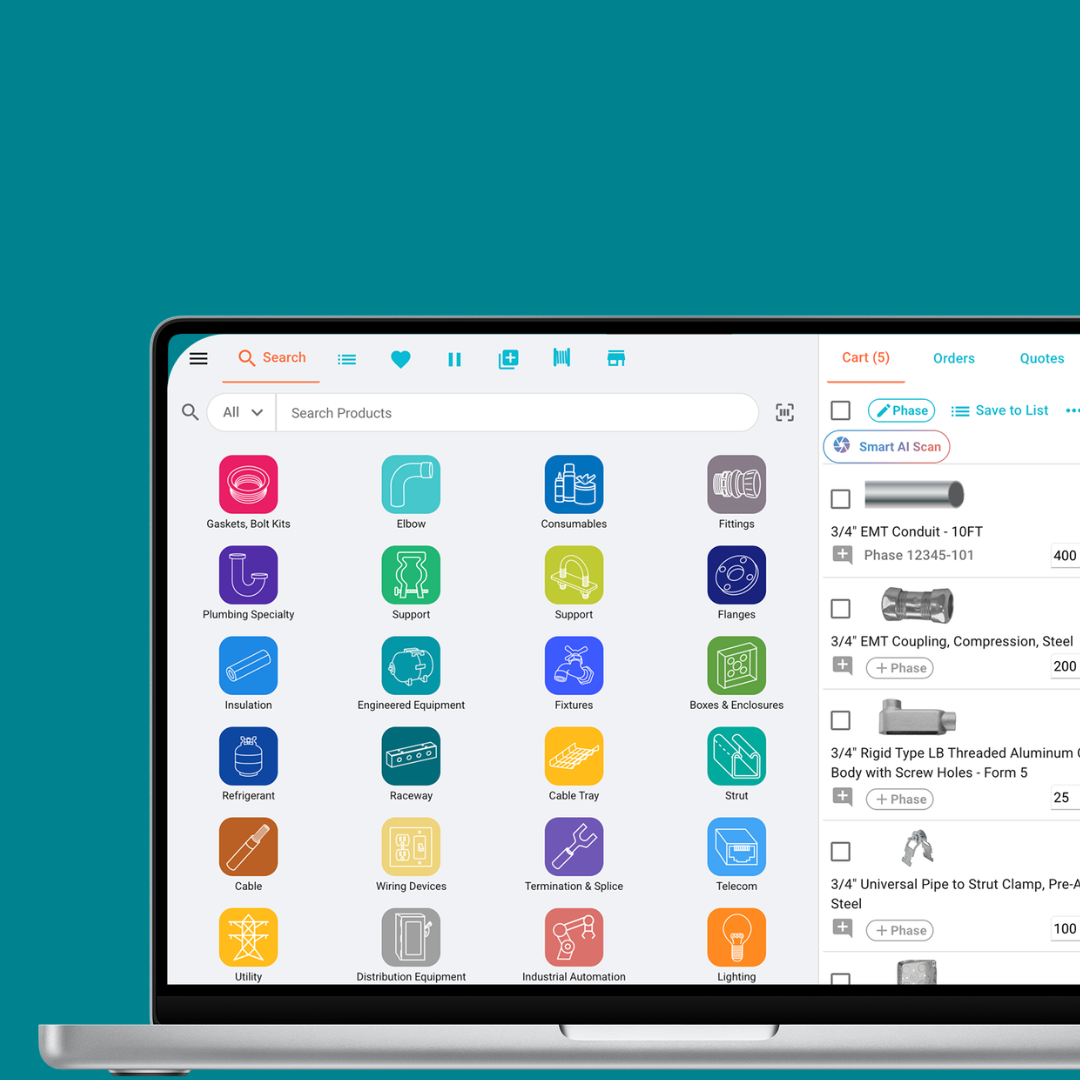
Construction inventory management software gives contractors a consolidated view of every material they own, across every location, in real time. Where a warehouse system tracks what's in one building, construction inventory software connects all of the locations where materials exist from the warehouse to the job sites, the prefab shop, the gang boxes, the service vans, and the trucks in between.
The core problem it solves is information fragmentation. A contractor buying $10M+ in materials per year has that inventory scattered across dozens of locations that change weekly. Without a system connecting them, each location operates blindly to what exists elsewhere. That's how duplicate purchasing, emergency orders, and idle inventory compound into margin erosion.
Core features of construction inventory management software
Any inventory system can track what's in a warehouse. The hard part is that construction materials live in a multitude of locations that change every week: a central warehouse, a prefab shop, multiple active job sites, various gang boxes, service vans, and trailers that move between projects. Construction inventory software handles six core functions:
The value comes down to a purchasing manager seeing consumption across all active jobs before placing an order. That supports better pricing on bulk purchases and times deliveries to actual need instead of safety stock built from uncertainty.
Construction inventory software vs. warehouse and ERP inventory modules
Generic warehouse management systems and ERP inventory modules are built around three assumptions that don't hold for contractors:
- Fixed locations. Warehouse systems assume inventory lives in one building, organized in bins and aisles. Construction materials live everywhere: warehouses, trucks, gang boxes, prefab shops, service vans, and sometimes still on the supplier's dock waiting for release. A system that can't track across all of these simultaneously doesn't solve the problem.
- Stable demand. ERP modules calculate reorder points based on historical consumption rates. That works for a manufacturer running the same production line every week. Construction demand is project-driven and not consistent The consumption patterns that make ERP logic work don't exist in project-based work.
- Clean SKUs. The same item goes by different names depending on who's asking. A field crew requests "Romex" when they mean NM-B cable, or asks for a "barrel connector" when the manufacturer calls it a "compression coupling." Morrow Meadows described the problem directly: "It's kind of like playing telephone. There's a translation issue of that they want a certain part, if you don't have those exact numbers, it's sometimes hard to remember everything to give to the vendor, and the vendor might be thinking of a different part." Generic systems treat these as different items. The result is phantom stockouts and over-ordering when field requests don't match catalog entries.
For contractors running at 5-6% average net margins, these failures have real financial consequences. Duplicate orders tie up working capital. Phantom stockouts trigger emergency purchases at premium prices. And 52% of rework is caused by poor data and miscommunication, exactly the kind of gap that widens when inventory systems can't translate between what the field calls one thing and how it’s listed in the catalog.
Multi-location inventory tracking and duplicate purchasing
Without multi-location visibility, every job site operates as an island. Two project managers order the same specialty item for different jobs because neither knows the other project has surplus sitting in a gang box. 20-35% of construction spending is "maverick spend" that happens outside of negotiated contracts, costing 5-20% more than managed purchasing. A meaningful portion of that comes from ordering materials that already exist somewhere else in the contractor's existing inventory.
Multi-location tracking changes the decision from "what do we need to order" to "what do we already have that can be transferred." That shift reduces new order volume and prevents the most expensive form of waste: buying materials you already own.
The value is clearest on high-cost items. Copper has surged past $5.60 per pound, and when a spool of 500 MCM costs thousands of dollars, knowing that three spools are sitting idle at a completed site has a direct cash flow impact. For contractors managing inventory across warehouses, job sites, and service vehicles, consolidated data also supports better supplier negotiations because the contractor can see total consumption across all jobs, not just one project at a time.
Inventory management for prefabrication and industrialized construction
Industrialized construction, the convergence of prefabrication, modular building, and offsite assembly, creates inventory requirements that are fundamentally different from traditional stick-built work.
In traditional construction, materials arrive at the job site and get installed in place. In prefab, materials flow through a production sequence: raw materials arrive at a shop, get assembled into components (electrical panels, conduit racks, piping assemblies), and those components ship to the job site. The material has to be in the right place at the right time in the production sequence, not just at the right location.
A prefab shop assembling multiple projects simultaneously needs to track what's been consumed, what's staged for production, and what still needs to arrive, all at the component level. Spreadsheets can't handle that complexity. B&D Industries saw their prefab productivity hours "almost triple" after adopting a system that could handle the coordination, going from scattered field requests to structured production workflows where "we can actually follow it from our request or the foreman's request all the way through to delivery."
Prefab is one of the primary strategies contractors use to hit compressed project timelines. But the speed advantage disappears if material delays disrupt the production schedule.
What to look for in construction inventory management software
When evaluating construction inventory software, the features that matter most are the ones that match the operational reality of running materials across multiple locations, projects, and teams:
The integration matters as much as the features. O'Connell Electric described the difference between connected and disconnected systems: "If there's an efficiency we find that will make the product work better for us or integrate tighter with our ERP, Clint and the development team have been phenomenal. We've had additional features added to the system within a day or two of requesting them." When inventory connects to procurement, field ordering, and accounting, material costs flow to the right jobs automatically instead of requiring manual reconciliation.
For mid-market contractors ($50M-$250M), adoption matters as much as features in the evaluation. 48% of construction firms cite training costs as the biggest barrier to technology adoption. Collins Electrical found the transition from their old process dramatic: procurement cycles that took "2-3 hours reduced to 10 minutes," with the biggest change being that "we were spending more time managing the procurement process than actually procuring materials."
For contractors whose material tracking has outgrown spreadsheets, Remarcable connects inventory visibility across every location to the procurement, field ordering, and accounting workflows that depend on accurate stock data. Start with one warehouse or one active job site: do a physical count and compare it to what your current tracking says. The gap between those two numbers is the cost of the visibility you don't have yet.
Connected purchasing and material operations for MEP contractors
See how contractors run procurement with Remarcable
Request a demo and we'll walk through exactly how it fits your team's workflow.
.png)