How Electrical Contractors Track Materials Across Job Sites, Vans, and Warehouses
Electrical inventory spans partial spools, calibrated tools, van stock, and long-lead switchgear.

Electrical contractors don't just carry more inventory than most trades. They carry more expensive, more varied, and harder-to-track inventory. Wire sold by the foot with partial spools across every job site. Switchgear with six-month lead times and staged delivery schedules. Van stock for service divisions that change after every call. And all of it priced against copper that has surged past $5.60 per pound, making untracked wire a theft risk as much as an accounting problem.
General-purpose inventory systems weren't built for this. They track units in a warehouse. Electrical contractors need visibility into materials that are in motion across warehouses, job sites, prefab shops, and service vehicles, all at the same time.
Inventory tracking challenges specific to electrical contractors
Electrical materials present unique tracking problems because of how they're measured, stored, and consumed. Partial spool consumption without running counts is the norm. After a few days of pulls, nobody knows whether a spool has 1,800 feet left or 400. The foreman orders a new spool to be safe, and the cost compounds silently across every active job.
Conduit and fittings are bulky, stored in multiple locations on large sites, and easily miscounted. EMT, rigid, and PVC in various diameters look similar enough that visual counts are unreliable. Switchgear carries six-month lead times and staged delivery schedules. Lighting fixtures are fragile, specific to room or area, and expensive to reorder after damage from improper storage.
General-purpose inventory systems track "units." They don't distinguish between wire by the foot, conduit by the stick, fittings by the count, and assemblies for switchgear. Paynecrest Electric described the gap: "When somebody would ask, how much is this job using or how much is the other job using? It was hard to pin that down." Software designed for the electrical trade tracks materials by the units that matter to the trade.
Material types and tracking requirements for electrical work
Each category of electrical material carries different tracking requirements:
For contractors running at 5-6% average net margins, 20-35% of spending that goes off-contract as "maverick spend" represents a direct margin hit. And 52% of construction rework traces back to poor data and miscommunication, exactly the kind of failure that compounds when inventory systems can't track what the trade actually needs.
Van stock management for electrical service divisions
Service divisions represent one of the fastest-growing business lines for electrical contractors. Maintenance contracts, NFPA 70B compliance inspections, and emergency repair work all generate recurring revenue beyond project-based income. But service work has its own inventory challenge: van stock.
An electrician's service van is a mobile warehouse carrying breakers, receptacles, switches, wire nuts, connectors, and dozens of other items. When a technician arrives at a customer’s site without the right breaker, the service call stalls. The technician drives to the supply house, the customer waits, and a job that should take 90 minutes takes four hours. Thirty-five percent of working time in construction goes to non-productive activities, and for service electricians, unplanned supply runs are a major contributor.
Inventory software that supports van stock tracking gives service managers visibility into what each vehicle carries and what's been consumed. When a technician uses three 20-amp breakers on a job, the system updates. When stock drops below a threshold, replenishment is triggered automatically. Paynecrest Electric described what this replaced: "Being able to set your parameter in Remarcable ensures us to keep everything, drill bits, everything, on the shelf. So being notified when something is low automatically, is awesome."
The alternative is asking technicians to manually count and report their inventory at the end of every week, which works about as well as asking foremen to manually track spool footage. The contractors building recurring revenue through service divisions need inventory visibility that extends to every vehicle in the fleet, not just the warehouse.
Supplier integrations for electrical distributors
Electrical contractors work with a concentrated set of suppliers: Graybar, WESCO, Rexel, CED, and regional distributors. The relationship is tight, built over years of negotiated pricing and credit terms.
When inventory software connects directly to those suppliers, it changes the reordering process. Instead of calling to check availability on a wire gauge, the system shows real-time pricing and stock levels. Instead of emailing a PO and waiting for confirmation, the order transmits through an EDI or API connection. This matters because of the volume electrical contractors operate at. Guarantee Electrical documented 135 orders in a single day with just two purchasers handling $200 million in annual material spend.
But integration depth varies. Lighthouse Electric described what they were dealing with before: "A lot of distributors want you to use their portal and place your orders through their portal, and then you go to another distributor, a different portal. You're now trying to learn two, three, four different systems." The shift to a single procurement platform that connects to all of them changed the workflow: "With Remarcable, it's one system. Everyone's learning one system. We're really in control of where we order, how we order."
The question when evaluating inventory software isn't "do you integrate with our suppliers?" It's whether the system can check pricing, confirm availability, place an order, and match the invoice against the PO without anyone re-entering data.
The expanding scope of electrical work and inventory complexity
Electrical contractors are evolving from installers to integrators, connecting power, technology, data, and building systems across the full project lifecycle. Smart building controls, EV charging infrastructure, solar installations, data center work, and industrial automation all fall under the electrical contractor's scope now. The number of unique SKUs on a single integrated project can run into the thousands, and the materials involved (network switches, controllers, sensors, charging stations) require coordination with other trades that traditional electrical work didn't.
This shift raises the inventory bar. A traditional commercial electrical project involves wire, conduit, panels, and fixtures. An integrated project adds specialty equipment with longer lead times, tighter tolerances, and higher per-unit costs. Missing a $50 box of MC connectors delays the electrical crew. Missing a $15,000 switchgear panel delays every trade behind them.
At the same time, project delivery schedules have compressed 10-20%. That leaves less room for material delays. When the inventory system shows exactly what's on site, what's on order, and what's in the warehouse, the project manager can plan around reality. When it doesn't, every material gap becomes an emergency. Guarantee Electrical found the impact went beyond just visibility: "Now we don't have to do spot checking. That is all done automatically through Remarcable. And if someone committed a price to us, they're held at that price, and if we don't receive that price, we're alerted to it."
Evaluating inventory software for electrical contractors
Not every inventory system fits the electrical trade. The requirements go beyond basic warehouse management:
For mid-market electrical contractors ($50M-$250M) who win through specialization and customer relationships rather than sheer scale, 48% cite training costs as the biggest barrier to technology adoption. Guarantee Electrical found that wasn't the barrier they expected: "If you can use Amazon, you can use Remarcable."
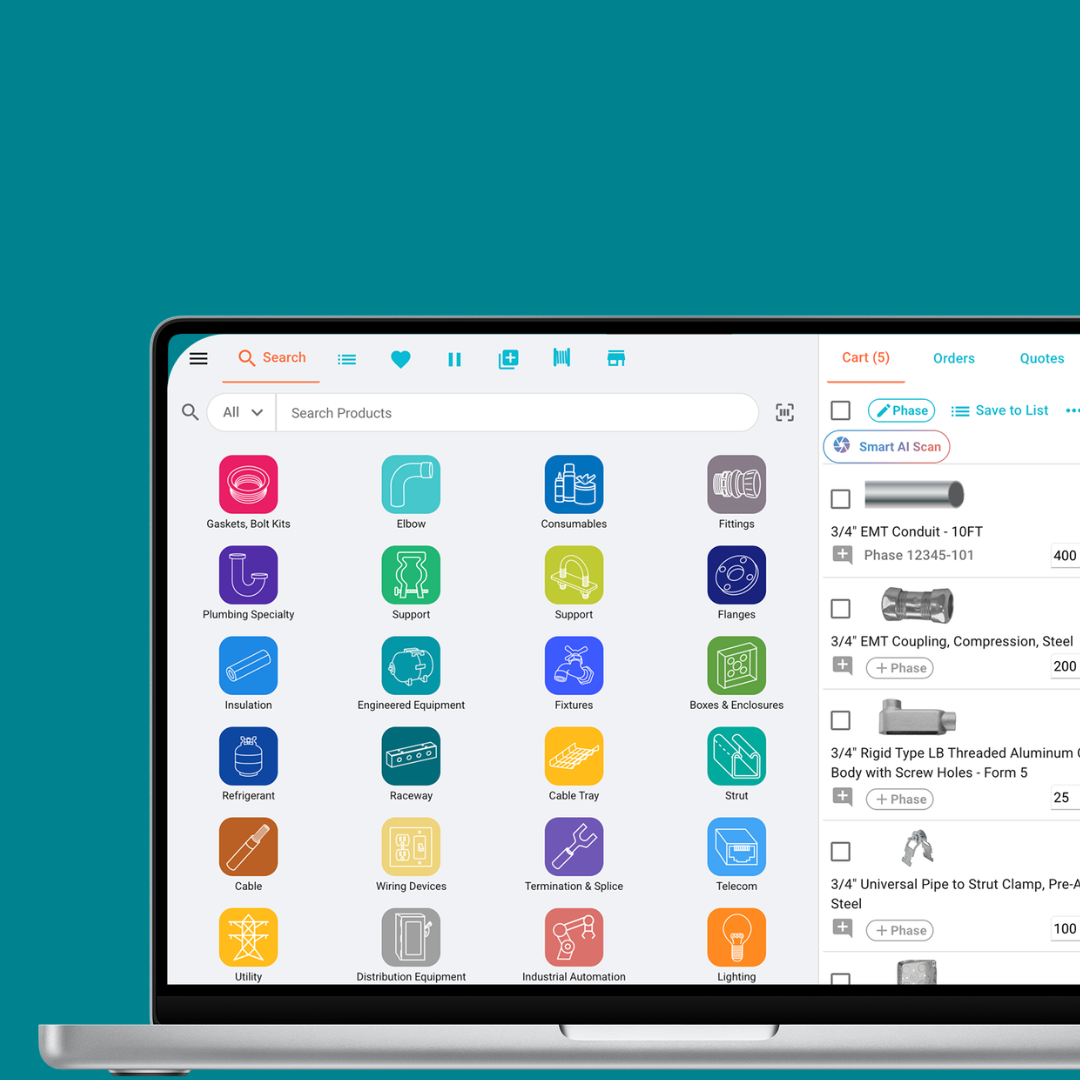
For electrical contractors looking to get material visibility right, Remarcable connects inventory tracking across every location to the procurement, supplier, and accounting workflows that depend on accurate stock data. The contractors who build these systems now are the ones who take on more work without adding proportional overhead. Faster response times, fewer emergency orders, and margins that hold up under schedule pressure.
Connected purchasing and material operations for MEP contractors
See how contractors run procurement with Remarcable
Request a demo and we'll walk through exactly how it fits your team's workflow.
.png)